Home›IELTS
IELTS is a four-skill English test used for study abroad, immigration and university admission. At 8020, every IELTS teacher holds a verified test score of 8.0 or above.
Real scores · Real teachers · Real results — teachers hold at least IELTS 8.0 or SAT 1500, and international programmes are taught by PhD and Master's holders.
IELTS is a 4-skill English test jointly owned by the British Council, IDP and Cambridge University Press & Assessment, used for study abroad, migration and university admissions. Two versions: Academic for university study, General Training for migration or below-degree study.
Universities, immigration authorities and professional bodies in the UK, Australia, Canada, New Zealand and the US use IELTS — one certificate that opens many doors.
Speaking is a face-to-face interview with an examiner — suits students who communicate more naturally with a person than with a machine.
In Vietnam computer-delivered IELTS runs almost every day, with most results in about 2 days; if you miss the mark in one skill you can retake just that skill (One Skill Retake).
From Grade 6 to university, the IELTS band is a clear yearly benchmark of your child's progress in academic English.
| IELTS | TOEFL iBT | PTE Academic | |
|---|---|---|---|
| Format in Vietnam | Computer-delivered (paper-based testing ended in Apr 2025); Speaking with a real examiner | Computer-delivered at IIG or at home (Home Edition) | Computer-delivered at Pearson test centres |
| Duration | About 2 hours 45 minutes | About 2 hours | About 2 hours |
| Score scale | 0–9 | 1–6 (plus 0–120 during the transition period) | 10–90 |
| Speaking and Writing scoring | Examiners mark against the band descriptors | Scored by AI, with human monitoring and training of the scoring engine | Scored by AI; since Aug 2025 a human also reviews the content |
| Results | Usually about 2 days, at most 5 days | About 3 days | Usually within 2 days |
| Suits | Study in the UK, Australia, Canada, New Zealand; migration; Vietnamese university admissions | Study in the US, Canada | Study and visas for Australia, New Zealand |
Clips from real 8020 classes and lessons — click to watch right here.
Each skill is scored on a 0–9 band (including .5). Overall = the average of the 4 skills, rounded to the nearest half band: an average ending in .25 rounds UP to .5; one ending in .75 rounds UP to the next whole band; below .25 rounds down. Example: L 6.5, R 6.5, W 5.0, S 7.0 → average 6.25 → Overall 6.5; average 6.75 → 7.0; average 6.125 → 6.0. CEFR equivalences are estimates based on Cambridge research, apply to the Overall score and are not exact equivalents.
(sources)
IELTS Academic is used for undergraduate/postgraduate study and professional registration (e.g. doctors, nurses); each university/organisation sets its own scores (Overall and minimum per skill) — check the 'Who accepts IELTS' tool or the university's admissions page.
Source ↗IELTS for UKVI (Academic/GT) is a SELT accepted by UKVI; IELTS for UKVI Life Skills A1/A2/B1 tests only Listening + Speaking, with a Pass/Fail result, and is used for some family/settlement visas. The required CEFR level (A1–C1) depends on the visa type.
Source ↗IELTS General Training is for people who want to migrate to an English-speaking country (ielts.org gives Australia, Canada, New Zealand and the UK as examples) or for training/study below degree level. Specific scores are set by each country's immigration authority.
Source ↗High school graduation exam regulations (Circular 24/2024, amended by Circular 13/2026/TT-BGDĐT, effective 24 Apr 2026), Appendix I: an IELTS score of 4.0 or above issued by the British Council or IDP exempts students from the Foreign Language exam for graduation recognition (the certificate must be valid on the date of exam registration). Students who still choose to sit the Foreign Language exam must use that exam score for graduation.
Source ↗Circular 06/2026/TT-BGDĐT (15 Feb 2026): foreign language certificates used for graduation exam exemption may be converted by universities into a foreign language subject score (out of 10) within the admission subject combination; the English conversion table is published by each university, with at least 5 score levels; a certificate may be used in ONLY ONE way — either converted to a foreign language score or as bonus points (up to 1.5/30).
Source ↗In Vietnam, since 29 Mar 2025 IELTS has been computer-delivered (Listening–Reading–Writing on computer, Speaking with an examiner in person or by video call). Hanoi and Ho Chi Minh City have sessions 7 days a week (BC: 9:00 and 14:00 sessions); provinces have fixed dates each month. Results are usually available in about 2 days (at most 5 days).
Two official providers: the British Council and IDP. Since 29 Mar 2025 IELTS in Vietnam has been computer-delivered (except for some special cases); in October 2026 a Writing on paper option was added at some venues. The fee is the same at both providers (VND 4,664,000); they differ in transfer/cancellation policy and venue network.
Cities with BC test venues (2026): Hanoi, Ho Chi Minh City, Phu Tho, Quang Ninh, Hai Phong, Hung Yen, Nghe An, Hue, Da Nang, Gia Lai, Khanh Hoa, Dong Nai, Thanh Hoa, Thai Nguyen, Lam Dong, Dak Lak.
IDP test venues (2026): Hanoi, Ho Chi Minh City (including former Binh Duong, Vung Tau, Ba Ria), Da Nang, Hai Phong, Can Tho, Dong Nai, Quang Ninh (Ha Long), Nghe An (Vinh), Thanh Hoa, Hung Yen (former Thai Binh), Thai Nguyen, Hue, Gia Lai (Quy Nhon, Pleiku), Quang Ngai, Lam Dong (former Binh Thuan), Dak Lak (Buon Ma Thuot), Dong Thap, Ninh Binh, Phu Tho (Vinh Phuc).
Writing on Paper in Vietnam (Oct 2026): IDP has sessions in Ho Chi Minh City, Hanoi and Da Nang; BC offers 'computer-delivered – Writing on paper' (see the registration system for specific venues) — not available for IELTS for UKVI.
Source: IDP Vietnam — IELTS fees 2026
| Time | Morning session / test day | Afternoon session |
|---|---|---|
| Hanoi, Ho Chi Minh City: Monday – Sunday every week | Session 9:00–12:00 (Listening, Reading, Writing back to back) | Ca 14:00–17:00 |
| October 2026 (provinces) | Da Nang: 4, 11, 17, 18, 24, 25, 31 · Hai Phong: 3, 10, 17, 24, 31 · Quang Ninh: 3, 10, 17, 24, 31 · Nghe An: 3, 10, 17, 24, 31 · Hue: 3, 10, 17, 24, 31 · Khanh Hoa: 3, 10, 17, 24, 31 · Dong Nai: 3, 10, 17, 18, 24, 25, 31 · Hung Yen: 10, 18, 24, 31 · Gia Lai: 10, 17, 24, 31 · Thanh Hoa: 11, 18, 25 · Phu Tho: 11, 25 · Dak Lak: 17, 31 · Thai Nguyen: 24 · Lam Dong: 24 | |
| November 2026 (provinces) | Da Nang: 1, 7, 8, 14, 15, 21, 22, 28, 29 · Hai Phong: 1, 7, 14, 21, 22, 28, 29 · Quang Ninh: 7, 14, 21, 28 · Nghe An: 1, 7, 8, 14, 15, 21, 22, 28, 29 · Hue: 1, 7, 14, 21, 22, 28, 29 · Khanh Hoa: 1, 7, 14, 21, 22, 28, 29 · Dong Nai: 1, 7, 14, 15, 21, 22, 28, 29 · Hung Yen: 7, 14, 21, 28 · Gia Lai: 7, 28 · Thanh Hoa: 8, 15, 22, 29 · Phu Tho: 15, 29 · Dak Lak: 7, 28 · Thai Nguyen: 21 · Lam Dong: 28 | |
| December 2026 (provinces) | Da Nang: 5, 6, 12, 13, 19, 20, 26 · Hai Phong: 5, 12, 19, 26 · Quang Ninh: 5, 12, 19, 26 · Nghe An: 5, 12, 19, 26 · Hue: 5, 12, 19, 26 · Khanh Hoa: 5, 12, 13, 19, 20, 26 · Dong Nai: 5, 6, 12, 13, 19, 20, 26 · Hung Yen: 5, 19 · Gia Lai: 19 · Thanh Hoa: 6, 13, 20 · Phu Tho: 13, 20, 27 · Dak Lak: 5, 19 · Thai Nguyen: 12 · Lam Dong: 26 |
Provincial dates per the BC Vietnam website, subject to change — check actual availability on the registration system.
Speaking may be on the same day or up to about 1 week before/after the main test date; candidates choose face-to-face or video-call with the examiner.
| Time | Morning session / test day | Afternoon session |
|---|---|---|
| Ho Chi Minh City, Hanoi, Hai Phong: 7 days a week | Academic & General Training on every test date | |
| Da Nang: every Tuesday, Wednesday, Friday, Saturday and Sunday | ||
| October 2026 (selected provinces) | Can Tho: 9, 10, 17, 23, 24, 31 · Dong Nai: 2, 3, 9, 10, 11, 17, 23, 24, 25, 30, 31 · Binh Duong: 10, 24, 31 · Vung Tau: 3, 4, 16, 17, 30, 31 · Ha Long: 3, 4, 10, 11, 17, 18, 24, 25, 31 · Vinh: 2, 3, 4, 9, 10, 11, 16, 17, 18, 23, 24, 25, 30, 31 · Thanh Hoa: 3, 4, 10, 11, 17, 18, 24, 25, 31 · Hue: 11, 18, 25 · Quang Ngai: 10, 24 · Buon Ma Thuot: 11, 25 · Gia Lai: 1, 10, 23, 24, 29 | |
| November 2026 (selected provinces) | Can Tho: 6, 7, 13, 14, 21, 27, 28 · Dong Nai: 8, 13, 14, 20, 21, 22, 27, 28 · Binh Duong: 14, 21, 28 · Ha Long: 1, 7, 8, 14, 15, 21, 22, 28, 29 · Vinh: 1, 6, 7, 8, 13, 14, 15, 20, 21, 22, 27, 28, 29 · Hue: 15, 22, 29 · Quang Ngai: 14, 28 | |
| December 2026 (selected provinces) | Can Tho: 4, 5, 11, 12, 26 · Dong Nai: 5, 12, 19, 20, 26 · Binh Duong: 5, 12, 19, 26 · Ha Long: 5, 6, 12, 13, 19, 20, 26, 27 · Vinh: 4, 5, 11, 12, 18, 19, 25, 26 · Quang Ngai: 12, 26 |
IDP says it is 'present in 16 provinces and cities'; the IDP venue page also lists sites such as Hue, Ninh Binh, Phu Tho and Dong Thap — see the full list and dates on the IDP test-date page.
In October 2026, IDP already offers 'computer-delivered IELTS – Writing on paper' sessions (e.g. 161 Hai Ba Trung, Ho Chi Minh City: 8:00 and 13:00 sessions).
| Item | 2026 (BC and IDP Vietnam) |
|---|---|
| IELTS Academic / General Training (computer-delivered, including the Writing on paper option) | VND 4,664,000 |
| IELTS for UKVI (Academic / GT) | VND 5,252,000 |
| IELTS for UKVI Life Skills | VND 4,414,000 |
| IELTS One Skill Retake | VND 2,940,000 |
| IELTS for UKVI One Skill Retake | VND 3,320,000 |
| Enquiry on Results — all types, 1 or 4 skills | VND 2,268,000 (refunded if your score goes up) |
| Express courier of score reports abroad (DHL) | VND 1,450,000/score report (BC) — VND 1,450,000/address, up to 500 g (IDP) |
| Domestic score report delivery (BC) | VND 200,000/score report |
| Additional TRFs after 1 month (IDP) | VND 200,000; online score reports are generated and sent free of charge |
| Changing your test date (IDP, changes made 4–14 days before the test date) | VND 1,100,000 |
| Rescheduling your Speaking test (IDP) | VND 900,000 |
BC and IDP list the same main test fee nationwide; payment in VND only.
IDP states its fees apply with 8% VAT from 01 Jul 2023 to 31 Dec 2026 — they may change from 2027; BC Vietnam gives no end date.
BC and IDP have DIFFERENT transfer/cancellation policies (see the rules).
Take a free placement test covering all 4 skills, and 8020 places you at the right stage — no starting over from scratch.
Rebuild foundational vocabulary, grammar and pronunciation and get familiar with the 4 skills — target 4.5, then keep going.
Cover every Listening and Reading question type and the Writing frameworks — target 6.5.
Raise Lexical Resource and Grammatical Range and build Reading speed — target 7.0+.
Only the criteria pulling your band down remain — test practice marked by 8.0–8.5 teachers.
Class names and band milestones follow 8020's current start-date schedule.
Click each skill to see timing, question types, band calculation, the criteria examiners use to mark Writing and Speaking under the band descriptors, plus free official sample tests.
| Section | Number of questions | Time | Notes |
|---|---|---|---|
| Part 1A conversation between two people in an everyday social context (e.g. arranging a trip). | 10 | — | 10/40 questions |
| Part 2A monologue (one main speaker) on an everyday topic (e.g. introducing local facilities). | 10 | — | 10/40 questions |
| Part 3A conversation between up to two main speakers in an education or training context (e.g. two students discussing, possibly with a tutor). | 10 | — | 10/40 questions |
| Part 4A monologue on an academic topic (lecture format). | 10 | — | 10/40 questions |
Computer-delivered (in Vietnam), listening through headphones; each recording is played only ONCE, with a range of accents (British, Australian, New Zealand, North American…); answers are typed directly on screen. The Listening test is the same for Academic and General Training.
| Section | Number of questions | Time | Notes |
|---|---|---|---|
| Part 1 — Introduction and interviewIntroduce yourself and answer questions on familiar topics: home, family, work, studies, interests. | — | 4–5 minutes | — |
| Part 2 — Long turnYou receive a task card and have 1 minute to prepare (a pencil and note paper are provided), then speak for about 2 minutes — the examiner stops you when time is up; 1–2 follow-up questions may follow. The whole part takes 3–4 minutes, including preparation time. | 1 | 3–4 minutes | — |
| Part 3 — DiscussionA deeper, more abstract discussion of issues related to the Part 2 topic. | — | 4–5 minutes | — |
A face-to-face 1-on-1 interview with a certified examiner (BC and IDP VN let you choose in person or by video call with the examiner, taken at the test venue); the session is recorded. BC VN: can be taken on the same day as Listening–Reading–Writing or up to one week before/after.
| Criteria | Band | What examiners look for |
|---|---|---|
| Fluency and coherence | 8 | Speaks fluently with only very occasional repetition or self-correction; any hesitation to search for words/grammar is rare, and is mostly to think about content; develops topics coherently, appropriately and relevantly. |
| Fluency and coherence | 7 | Speaks at length without noticeable effort; occasional hesitation, repetition or self-correction mid-sentence while searching for words, but without loss of coherence; uses connectives and discourse markers flexibly. |
| Fluency and coherence | 6 | Willing to speak at length; sometimes loses coherence due to hesitation, repetition or self-correction; uses a range of connectives, though not always appropriately. |
| Fluency and coherence | 5 | Usually maintains the flow of speech but relies on repetition, self-correction or slow speech; frequently hesitates to search for basic words/grammar; overuses certain connectives; complex ideas cause loss of fluency. |
| Criteria | Band | What examiners look for |
|---|---|---|
| Lexical resource | 8 | Wide vocabulary used flexibly across all topics to convey precise meaning; skilful use of less common words and idioms, with occasional collocation errors; effective paraphrase. |
| Lexical resource | 7 | Uses vocabulary flexibly across a range of topics; uses some less common and idiomatic items with awareness of style and collocation, though with some inappropriacies; paraphrases effectively. |
| Lexical resource | 6 | Enough vocabulary to speak at length on a range of topics; may use inappropriate words but meaning remains clear; generally able to paraphrase. |
| Lexical resource | 5 | Enough vocabulary for familiar and unfamiliar topics but with limited flexibility; attempts to paraphrase, not always successfully. |
| Criteria | Band | What examiners look for |
|---|---|---|
| Grammatical range and accuracy | 8 | Uses a variety of structures flexibly; most sentences are error-free, with only occasional, non-systematic errors; a few basic errors may remain. |
| Grammatical range and accuracy | 7 | Uses a range of structures flexibly; error-free sentences are frequent; both simple and complex sentences are used effectively despite some errors; a few basic errors remain. |
| Grammatical range and accuracy | 6 | Mixes short and complex sentences with a variety of structures but limited flexibility; complex sentences often contain errors but rarely impede communication. |
| Grammatical range and accuracy | 5 | Simple sentences are fairly accurate; attempts complex sentences but with limited range, nearly always with errors, and may need to rephrase. |
| Criteria | Band | What examiners look for |
|---|---|---|
| Pronunciation | 8 | Uses a wide range of pronunciation features to convey precise/subtle meaning; sustains appropriate rhythm, with flexible stress and intonation in long utterances despite occasional lapses; easy to understand throughout, with minimal effect of accent. |
| Pronunciation | 7 | Has all the positive features of band 6 and some (but not all) features of band 8. |
| Pronunciation | 6 | Uses a range of pronunciation features with mixed control; chunking is generally appropriate but rhythm may be affected; intonation and stress are at times effective but not sustained; mispronunciation of some words/sounds only occasionally reduces clarity; generally understood without much difficulty. |
| Pronunciation | 5 | Has all the positive features of band 4 and some (but not all) features of band 6. |
| Section | Number of questions | Time | Notes |
|---|---|---|---|
| Academic — 3 sections (3 long passages)Three sections totalling about 2,150–2,750 words, taken from books, journals, magazines, newspapers and online sources; written for a non-specialist audience on topics suitable for undergraduate/postgraduate students; at least one text contains detailed logical argument. | 40 | 60 minutes for the whole test | 40 questions × 1 point |
| General Training — Section 1Two or three short texts, or several shorter texts, about everyday life: notices, advertisements, timetables… The three GT sections increase in difficulty. | — | — | — |
| General Training — Section 2Two texts on work-related topics: job descriptions, contracts, training materials, staff development… | — | — | — |
| General Training — Section 3A longer text on a general topic, taken from popular publications. The three parts total about 2,150–2,375 words, 40 questions, 60 minutes. | — | — | — |
Computer-delivered (in Vietnam): the text is on the left, questions on the right, with highlighting/note tools. Academic and General Training have DIFFERENT reading texts.
| Section | Number of questions | Time | Notes |
|---|---|---|---|
| Task 1 — AcademicAt least 150 words. Describe in your own words visual information: one or more graphs, charts, tables, or diagrams of an object, device, process or event; academic or semi-formal/neutral style. | 1 | Suggested ~20 minutes | Worth 1/3 of the Writing score (Task 2 carries twice the weight of Task 1) |
| Task 1 — General TrainingAt least 150 words. Write a letter responding to an everyday situation; the tone is informal, semi-formal or formal depending on the recipient; you must address the bullet points given. | 1 | Suggested ~20 minutes | Worth 1/3 of the Writing score |
| Task 2 — Academic & General TrainingAt least 250 words. An essay discussing a point of view, argument or problem; it needs a clear position, developed ideas and examples. | 1 | Suggested ~40 minutes | Worth 2/3 of the Writing score |
Computer-delivered, typed on screen. In Vietnam there is now a 'Writing on Paper' option (questions shown on screen, answers handwritten on an answer sheet with a pen provided; not available for IELTS for UKVI). You must write complete sentences in continuous prose, not notes or bullet points.
| Criteria | Band | What examiners look for |
|---|---|---|
| Task Achievement | 8 | Sufficiently, appropriately and fully addresses the task requirements. Academic: key features are skilfully selected, clearly highlighted and illustrated. GT: all bullet points are clearly presented and appropriately extended. There may be occasional minor omissions. |
| Task Achievement | 7 | Covers the requirements of the task; content is relevant and accurate (with possible minor omissions); format is appropriate. Academic: key features are clearly highlighted but could be more fully illustrated; a clear overview, data sensibly grouped, main trends/differences identified. GT: all bullet points covered and clearly highlighted (could be extended); clear purpose; consistent and appropriate tone. |
| Task Achievement | 6 | Focuses on the task requirements, with an appropriate format. Academic: attempts an overview, selects information sensibly and cites data. GT: covers the bullet points reasonably, the purpose is generally clear, and the tone is inconsistent in places. There may be irrelevant, missing or inaccurate details. |
| Task Achievement | 5 | Generally meets the task requirements; the format is inappropriate in places. Academic: the key features selected are not adequately covered, details are reported mechanically, and there may be no data to illustrate. GT: all bullet points are covered but some are not fully developed, the purpose is sometimes unclear and the tone is inconsistent. May focus on details without seeing the big picture; irrelevant/inaccurate information in key parts lowers the score. |
| Criteria | Band | What examiners look for |
|---|---|---|
| Task Response | 8 | Addresses the task appropriately and fully; a clear, well-developed position; relevant, extended and well-supported ideas; only occasional omissions or lapses in content. |
| Task Response | 7 | The main parts of the prompt are addressed appropriately; a clear position is presented and developed; main ideas are extended and supported but may be over-generalised or supporting evidence may lack focus and accuracy. |
| Task Response | 6 | Addresses the main parts of the task (some more fully than others); presents a relevant position, though conclusions may be unclear, unjustified or repetitive; main ideas are relevant but some are insufficiently developed, with weak support in places. |
| Task Response | 5 | Responds only partially to the main parts; states a position but its development is not always clear; main ideas are limited, insufficiently developed or include irrelevant details; ideas may be repeated. |
| Criteria | Band | What examiners look for |
|---|---|---|
| Coherence & Cohesion | 8 | Easy to follow; ideas logically organised, cohesion well managed; adequate and appropriate paragraphing; only occasional lapses. |
| Coherence & Cohesion | 7 | Ideas are logically organised with clear progression throughout; a range of cohesive devices (including reference and substitution) is used flexibly, though with some inaccuracies or over/under-use. |
| Coherence & Cohesion | 6 | Generally coherent, with clear overall progression; cohesive devices are used effectively, but cohesion within/between sentences is sometimes mechanical or faulty; limited use of substitution leads to repetition. |
| Coherence & Cohesion | 5 | Organised but not fully logical, lacking overall progression; sentences not linked smoothly; cohesive devices limited/overused and with errors; may be repetitive due to poor referencing and substitution. |
| Criteria | Band | What examiners look for |
|---|---|---|
| Lexical Resource | 8 | Wide vocabulary used fluently and flexibly to convey precise meaning; skilful use of less common words/idioms where appropriate; only occasional errors in word choice, collocation or spelling. |
| Lexical Resource | 7 | Sufficient vocabulary to allow some flexibility and precision; uses some less common words; aware of style and collocation, though sometimes inappropriate; few spelling/word formation errors. |
| Lexical Resource | 6 | Vocabulary generally adequate for the task; meaning is clear despite a limited range or imprecise word choice; spelling/word formation errors that do not impede communication. |
| Lexical Resource | 5 | Limited vocabulary, only minimally adequate; little variation, frequent simplification/repetition; noticeable errors in spelling and word formation that may cause difficulty for the reader. |
| Criteria | Band | What examiners look for |
|---|---|---|
| Grammatical Range & Accuracy | 8 | Uses a wide range of structures flexibly and accurately; most sentences are error-free and punctuation is well managed; only occasional, non-systematic errors with minimal impact on communication. |
| Grammatical Range & Accuracy | 7 | Uses a range of complex structures with some flexibility and accuracy; error-free sentences are frequent; a few grammatical errors remain but do not impede communication. |
| Grammatical Range & Accuracy | 6 | Mixes simple and complex sentences but with limited flexibility; complex sentences are less accurate than simple ones; grammatical/punctuation errors occur but rarely impede communication. |
| Grammatical Range & Accuracy | 5 | Limited, repetitive structures; attempts complex sentences but they are often wrong; grammatical errors may be frequent and cause difficulty for the reader; punctuation may be faulty. |
Based on ielts.org, the British Council and IDP. Sample tests and band descriptors open directly from the official websites; copyright belongs to the IELTS partners. Updated 07/10/2026.
8020 students learn with teachers in class and practise at home in the IELTS practice platform — a test bank covering all 4 skills, with AI scoring Writing and Speaking against the 4 criteria of the band descriptors.
The author claims that early maps were mainly used for navigation.
Lexical Resource and Grammatical Range below band 6 → the teacher corrects sentences and assigns catch-up work
40 questions · heard once — just like the real test
Every IELTS teacher has a score report of 8.0 or above; the IELTS Academic Head scored 8.5, holds a Master's from Western Sydney University (Australia) and has over 10 years of IELTS teaching.
Writing and Speaking are scored on the 4 criteria examiners use — you know exactly which criterion is pulling your band down so you can fix it.
A 4-stage path from no foundation to 7.5+, with class placement by a 4-skill test; small groups so the teacher can correct each student's work.
A test bank covering all 4 skills in the 8020 IELTS practice platform, with AI scoring Writing and Speaking right after you submit — teachers review the difficult pieces.
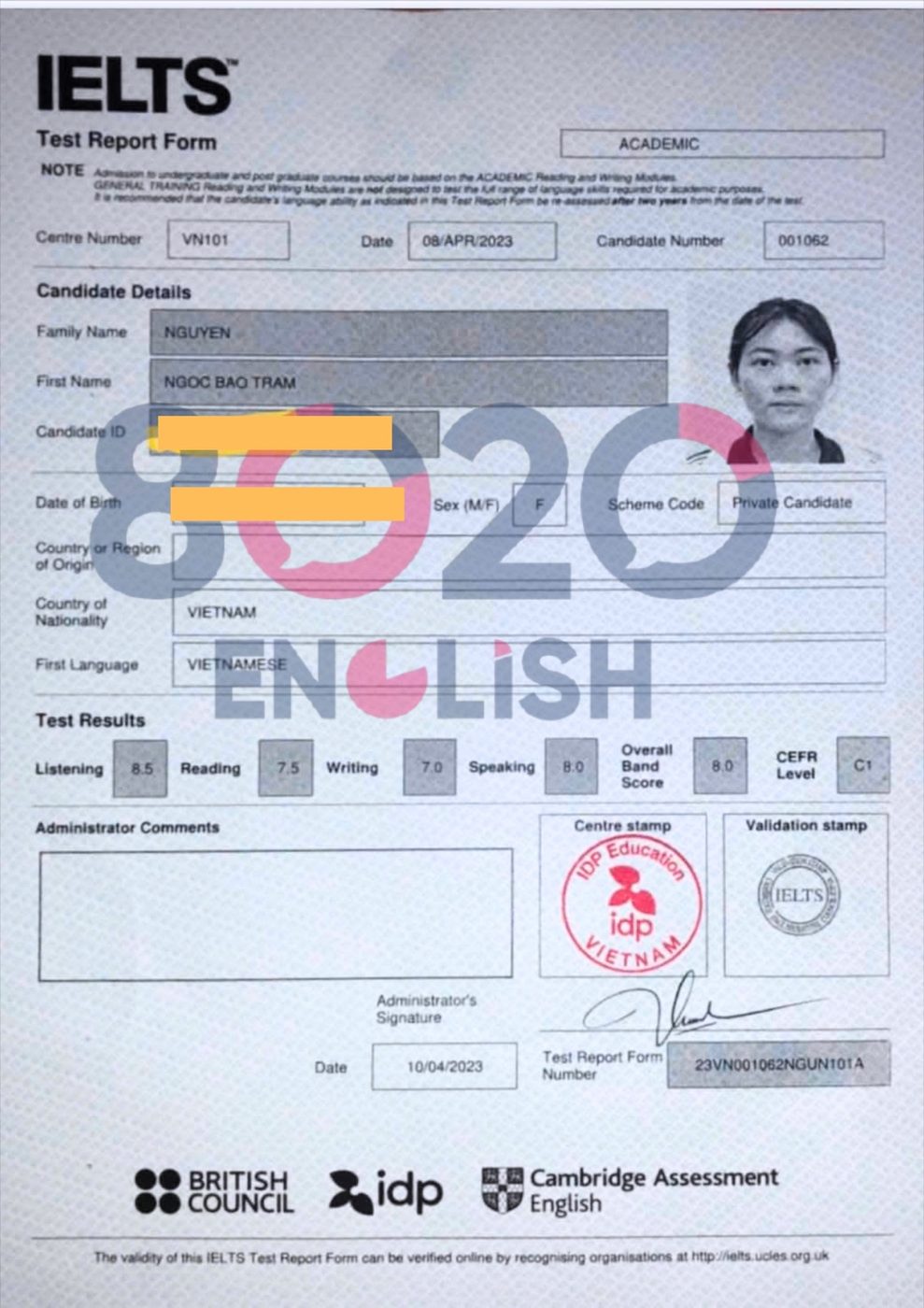
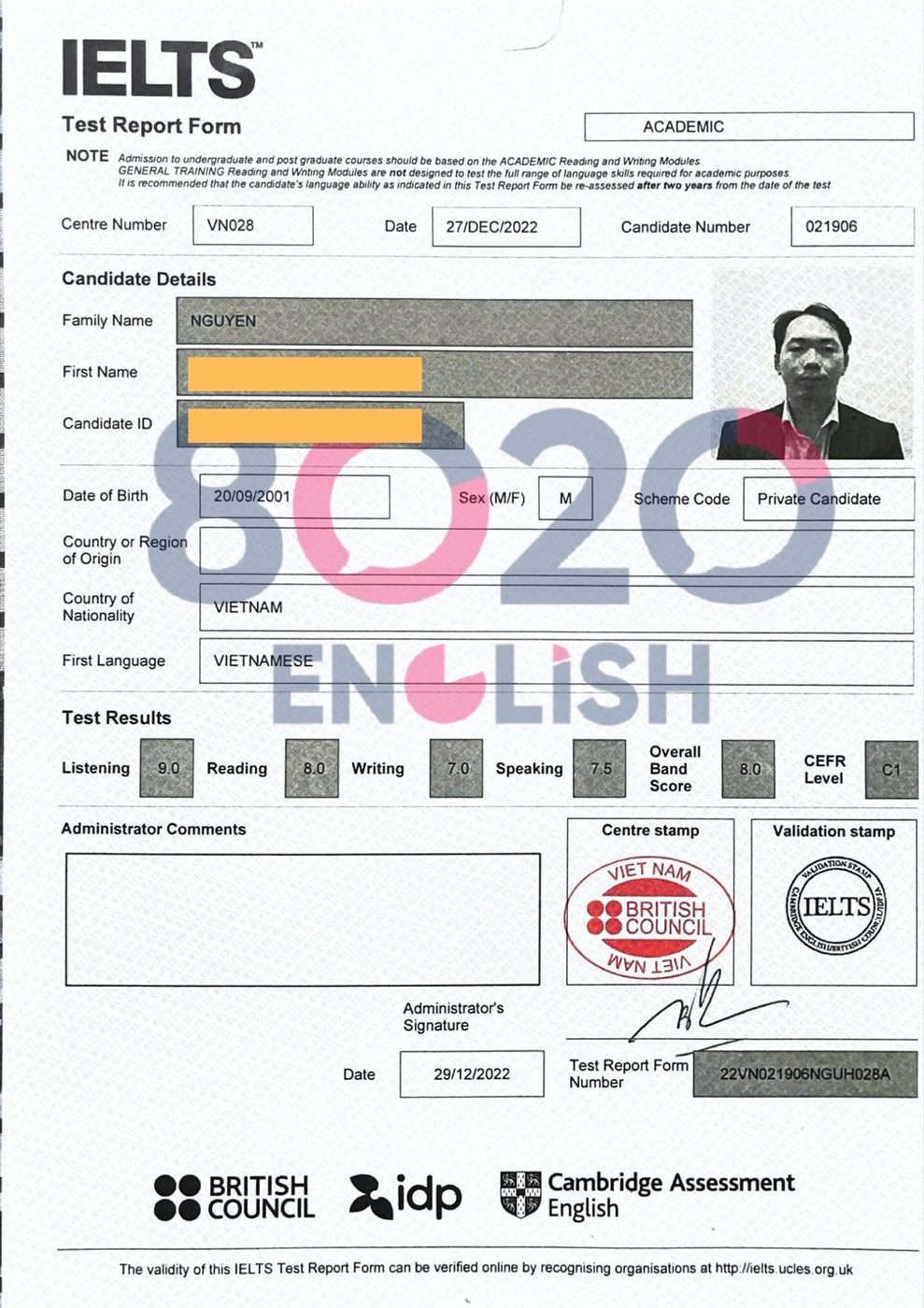
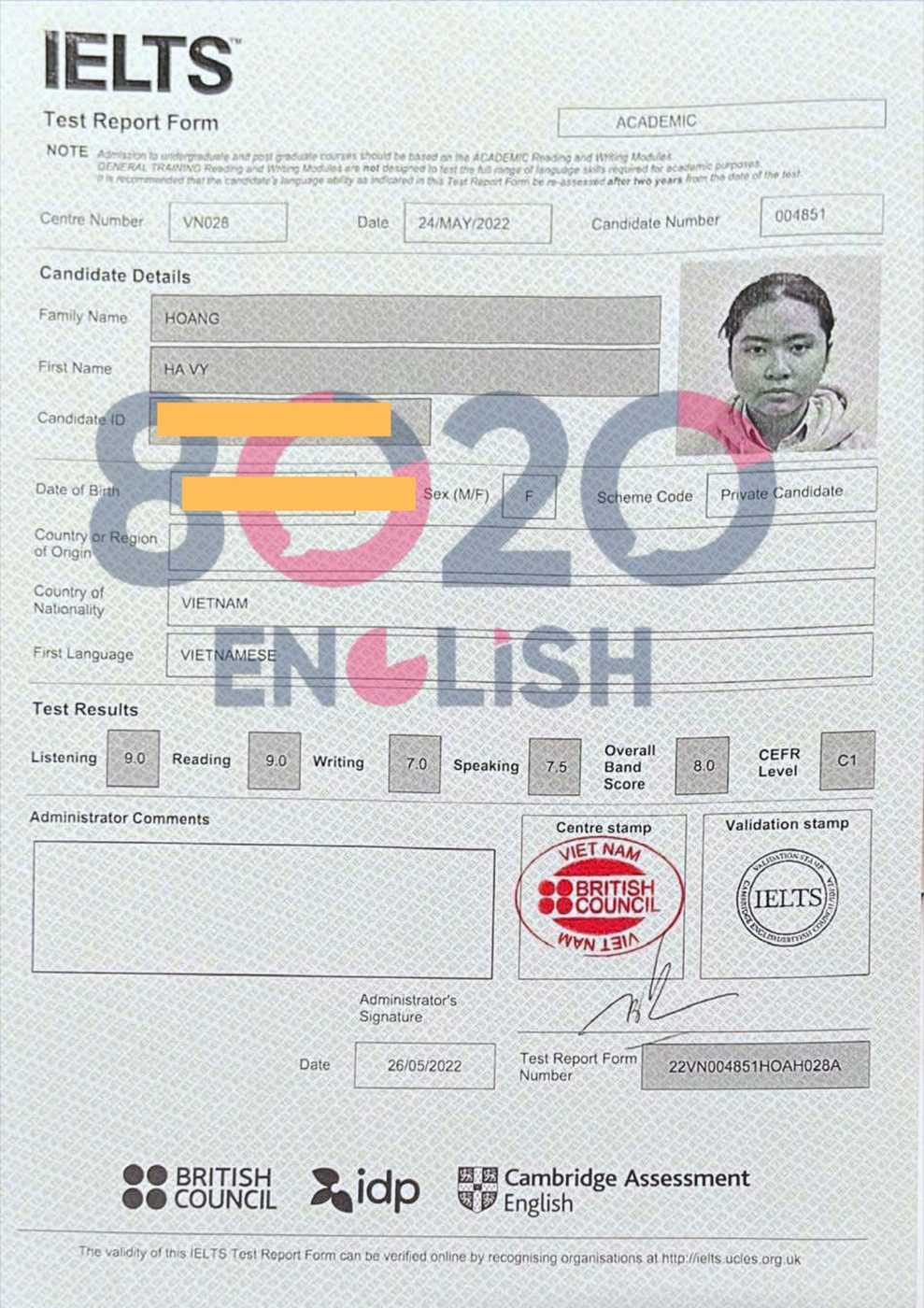
Scores are shown as they appear on each student's real IELTS score report.

Master's, Western Sydney (Australia) · Talented Engineer Programme, Bách Khoa (Ho Chi Minh City University of Technology) · First Prize in Mathematics at city level, Mathematics specialist class at Lê Hồng Phong · over 10 years teaching IELTS and SAT

Phổ thông Năng khiếu (High School for the Gifted, VNU-HCM) · Deutschlandstipendium and Odon Vallet scholarships · First Prize, National Student Physics Olympiad



IELTS certificates of 8020 students. Click an image to enlarge.
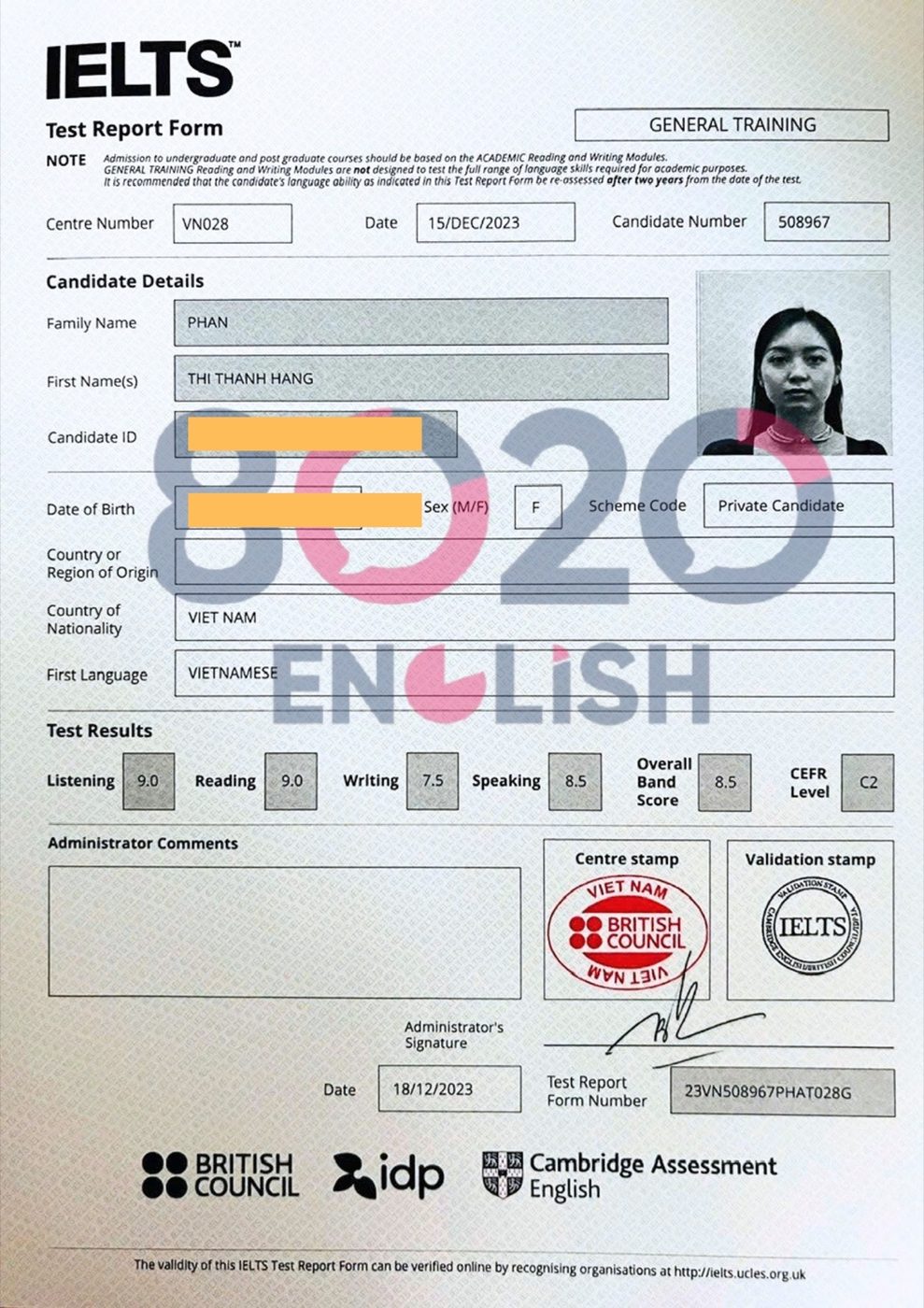
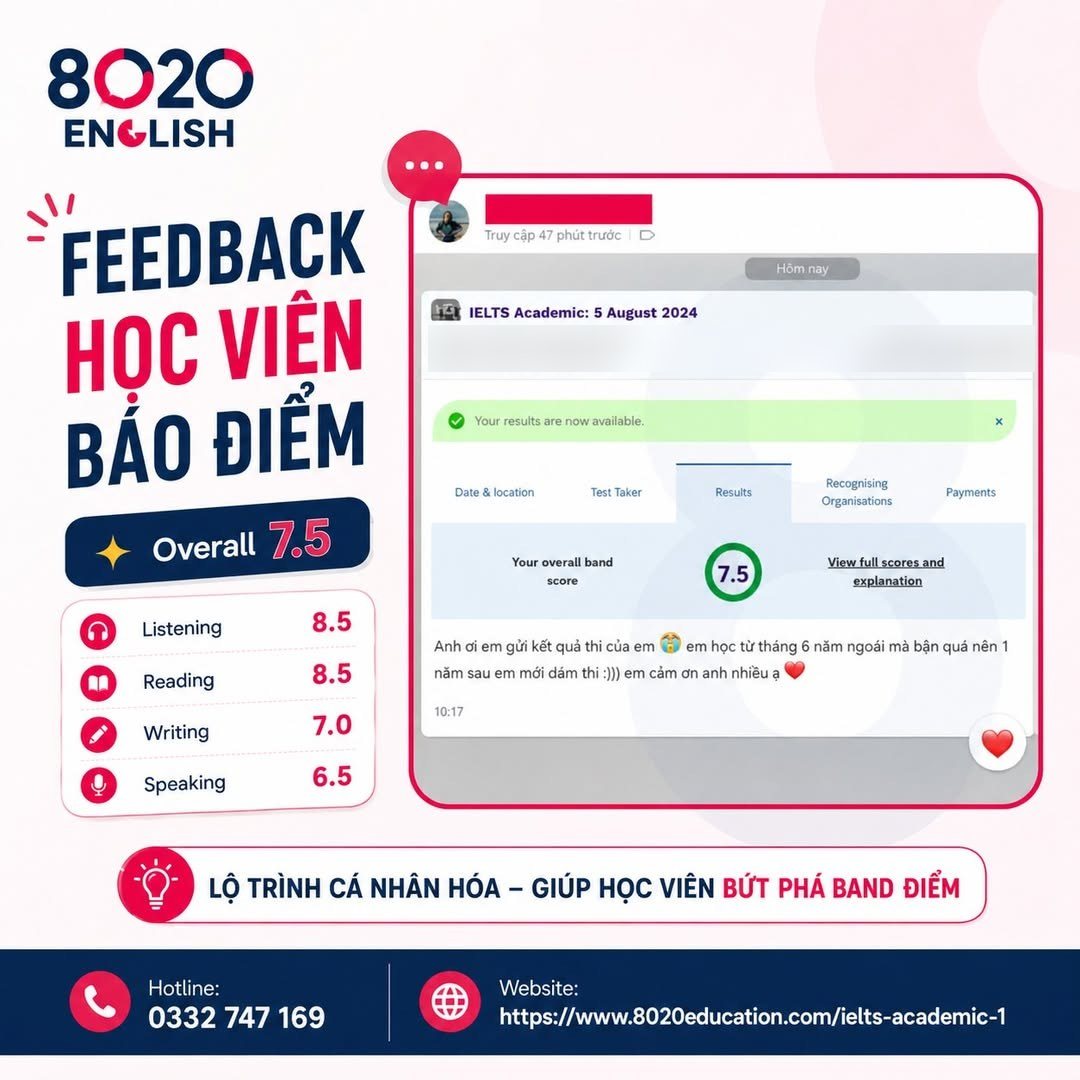
em học từ tháng 6 năm ngoái mà bận quá nên 1 năm sau em mới dám thi :))) em cảm ơn anh nhiều ạI started in June last year but was so busy I only dared to sit the test a year later :))) thank you so muchStudent reports score by message
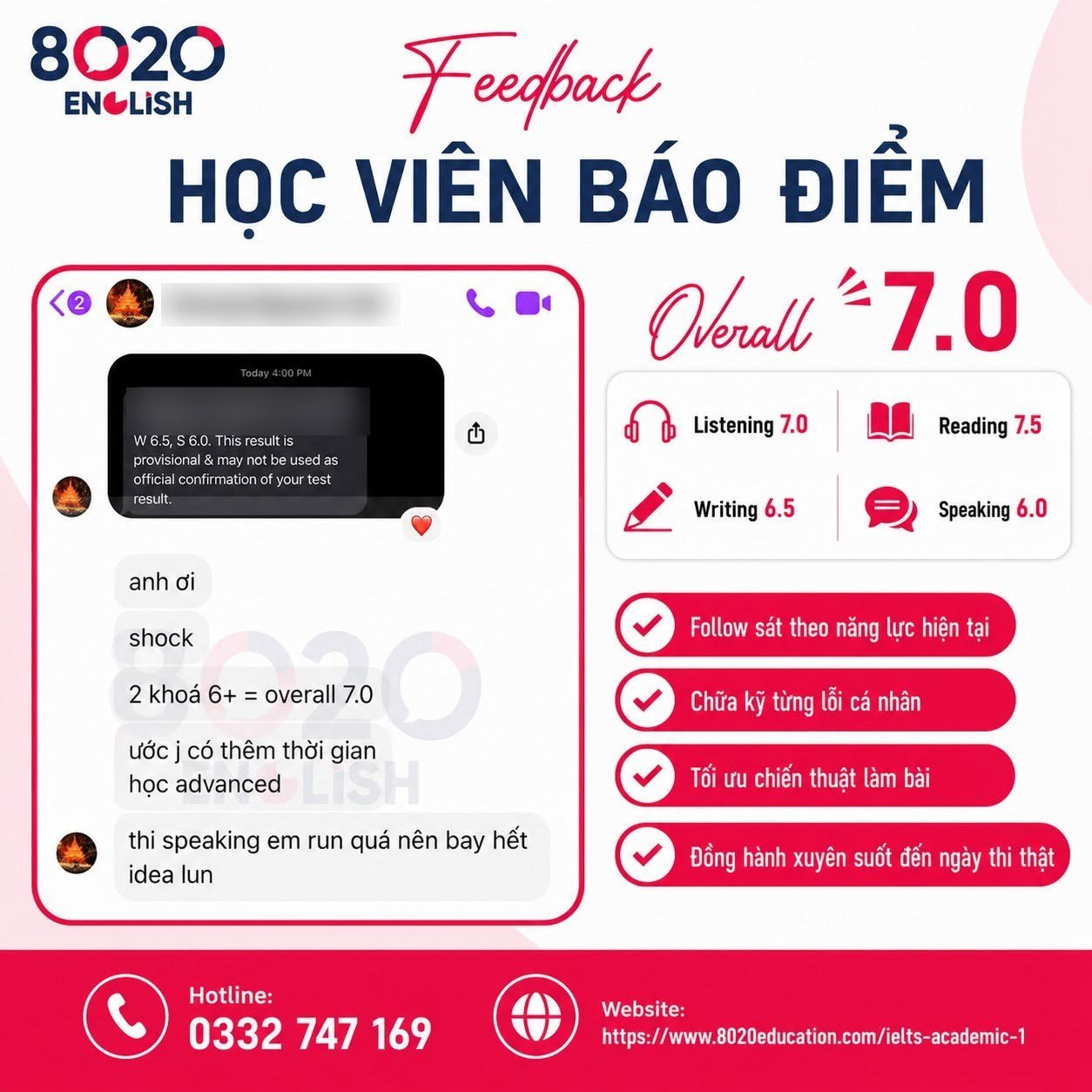
2 khoá 6+ = overall 7.02 courses for 6+ = overall 7.0Student reports score via Messenger
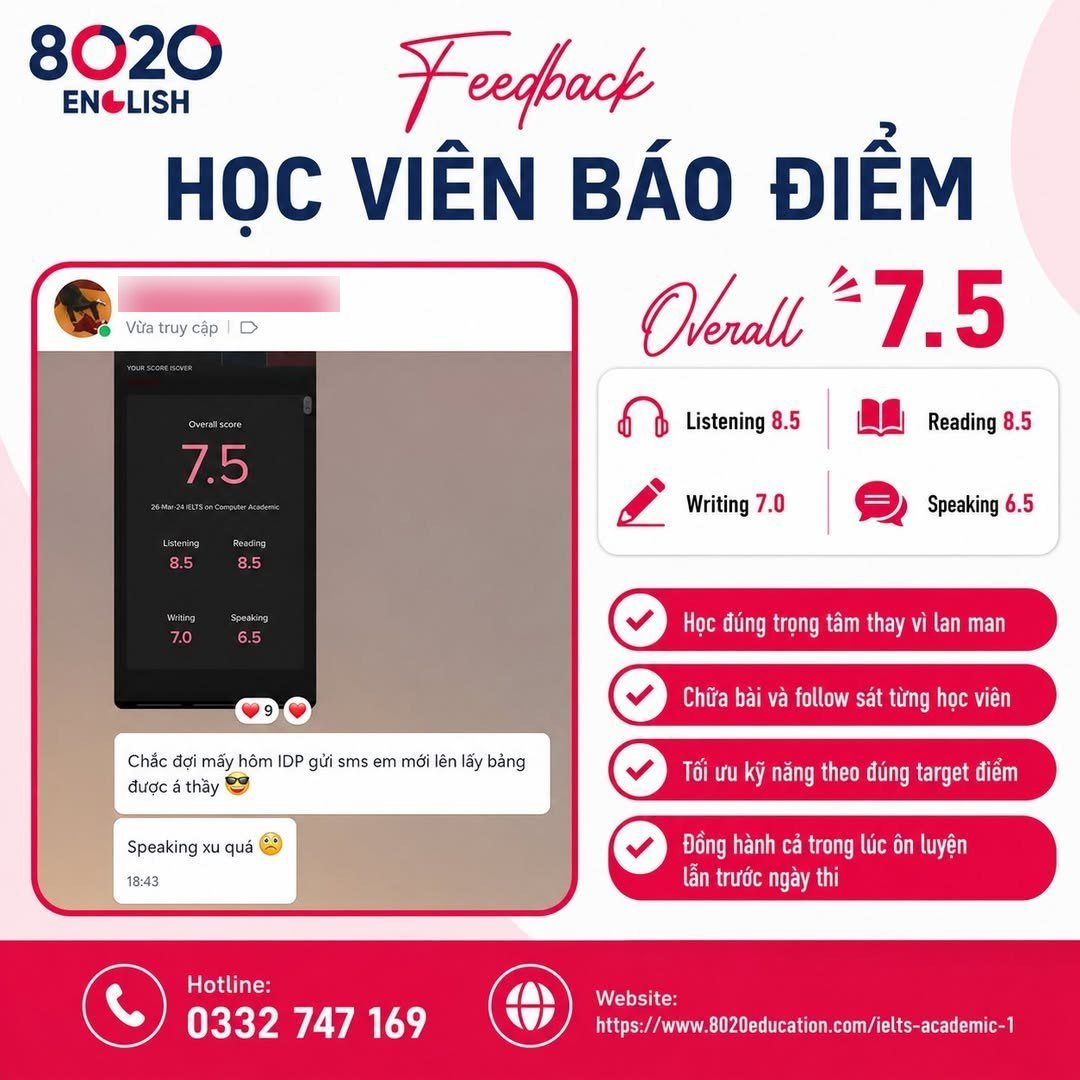
Chắc đợi mấy hôm IDP gửi sms em mới lên lấy bảng được á thầyI guess I'll pick up the certificate once IDP texts me in a few days, teacherStudent reports score by message
Classes are assigned by a free placement test — you study exactly the stage you are missing, without starting over.
Take the average of the 4 skills and round to the nearest half band: .25 rounds up to .5, .75 rounds up to the next whole band. Example: 6.5 + 6.5 + 5.0 + 7.0 = 25 → 6.25 → Overall 6.5 (ielts.org).
VND 4,664,000 for Academic/General Training at both BC and IDP; IELTS for UKVI VND 5,252,000; One Skill Retake VND 2,940,000; Enquiry on Results VND 2,268,000 (BC Vietnam and IDP Vietnam fee pages).
No. Since 29 Mar 2025 IELTS in Vietnam has been computer-delivered only, except for candidates needing special arrangements and a limited number of cases for educational institutions (IDP VN). In October 2026 some venues added an option to take the test on computer but handwrite the Writing section on paper; results in 1–5 days.
Computer-delivered: most scores are available in about 2 days, at most 5 days. IELTS recommends that results reflect ability for up to 2 years; most organisations do not accept TRFs older than 2 years, though some accept older ones (ielts.org, BC VN).
Optional: IELTS One Skill Retake lets you retake 1 skill within 60 days of the original computer-delivered test, once per test, fee VND 2,940,000. Check whether your university/organisation accepts OSR (ielts.org, IDP VN).
IELTS 4.0 or above issued by BC or IDP and still valid on the date of exam registration (Appendix I, High School Graduation Exam Regulations — consolidated text after Circular 13/2026/TT-BGDĐT). For university admissions, institutions either convert IELTS into an English subject score using their own table (≥5 levels) OR award bonus points — not both (Circular 06/2026/TT-BGDĐT).
According to IELTS data for 2024–2025 (Academic, Vietnamese nationals): Listening 6.49; Reading 6.38; Writing 6.06; Speaking 5.61; Overall 6.20 — Speaking is lowest, Listening highest.
Each task is scored on 4 equally weighted criteria (Task Achievement/Response, Coherence & Cohesion, Lexical Resource, Grammatical Range & Accuracy); Task 2 counts twice as much as Task 1 towards the Writing band (ielts.org).
BC: free transfer 15 or more days ahead (up to 5 times), 25% of the fee at 5–14 days; cancel 15 or more days ahead for a 75% refund, no refund within 14 days. IDP: free transfer 15 or more days ahead, VND 1,100,000 fee at 4–14 days, one transfer only; cancel more than 15 days ahead for a 75% refund.
Academic is for undergraduate/postgraduate study and professional registration; General Training is for migration (e.g. Australia, Canada, New Zealand, UK) or below-degree study and training. Listening and Speaking are the same; Reading and Writing differ (ielts.org).
University and postgraduate study require Academic; migration or below-degree study usually requires General Training — check the exact requirement with your university or immigration authority. Both versions share Listening and Speaking, and differ in Reading and Writing Task 1.
Same test and scoring as the former paper test; Speaking is still with a real examiner. In Vietnam only the computer-delivered test is now available — practise typing Writing and doing Listening and Reading on the computer interface before test day.
It depends on your starting point and self-study time; lower bands rise faster than higher ones. 8020 assigns stages by an entry test so every course has a clear target.
Small groups across 4 band stages, an exam-prep class for students already at 6.5+, and 1-on-1 · 1-on-2 tutoring on your own schedule. Start with a free placement test covering all 4 skills.
The articles below are currently available in Vietnamese only.
Sample answers & IELTS articles on IELTS8020 → · View the full 8020 blog →
Take the free placement test and 8020 will pinpoint your gaps and place you in the right class with the right teacher. A question bank covering all 4 skills, with AI marking for Writing & Speaking.