Home›SAT
The SAT is College Board's standardized test, used for admission to US universities and to a growing number of universities in Vietnam. Since 2024 the SAT has been taken entirely on computer (Digital SAT).
Real scores · Real teachers · Real results — teachers hold at least IELTS 8.0 or SAT 1500, and international programmes are taught by PhD and Master's holders.
The SAT is the College Board's standardised test used for admission to US universities and many universities worldwide. Since 2024 the SAT has been taken entirely in the Bluebook app: two sections, Reading and Writing and Math, each with two adaptive modules, scored on a 400–1600 scale.
SAT scores let universities compare students from different school systems — transcripts from Vietnam and from the US are read on the same scale.
Many universities and scholarship programmes use the SAT in admissions; a high score helps your application stand out among international applicants.
The international SAT runs several times a year and can be retaken; many universities consider your highest score — see the schedule and score-sending rules below.
About 2 hours 14 minutes; module 2 is harder or easier depending on your module 1 results; the Desmos calculator built into Bluebook can be used throughout the Math section.
| SAT | ACT | |
|---|---|---|
| What's tested | Reading and Writing · Math | English · Math · Reading (Science and Writing optional) |
| Test format | On a computer, in the Bluebook app, adaptive by module | Not adaptive — every candidate takes the same test |
| Score scale | 400–1600 | 1–36 |
| Calculator | Allowed throughout the Math section (built-in Desmos) | Allowed in the Math section |
| Suits | You are strong in algebra and read short passages carefully | You read fast and are comfortable with data and tables |
Clips from real 8020 classes and lessons — click to watch right here.
Total score 400–1600 = Reading and Writing (200–800) + Math (200–800), in 10-point increments. Percentile = % of test takers scoring at or below you. 'User group' is based on actual test takers from the 3 most recent graduating classes; 'Nationally representative' is a representative sample of US Grade 11–12 students. ACT equivalents follow the official 2018 concordance tables (College Board + ACT) — the tables currently published by the College Board.
(sources)
According to official admissions pages (checked Oct 2026): MIT, Harvard, Yale, the University of Pennsylvania and Caltech require the SAT or ACT; Princeton reinstates the requirement from the 2027-28 admissions cycle (still optional for 2026-27). Yale accepts superscores; Harvard allows substitution with other credentials only in exceptional cases — see each page.
Source ↗Requires the SAT or ACT; alternative credentials are accepted only in exceptional cases where the tests are inaccessible.
Source ↗First-year and transfer applicants must submit the ACT or SAT; self-reported scores are allowed and superscores are accepted.
Source ↗SAT/ACT required (with a waiver for hardship); latest SAT dates: ED 7 Nov 2026, RD 5 Dec 2026; SAT code 2926.
Source ↗SAT or ACT required again from the 2027-28 admissions cycle (fall 2028 entry); the 2026-27 cycle (fall 2027 entry) remains test-optional.
Source ↗Free: choose which scores to send by TEST DATE (you cannot combine RW from one date with Math from another). Some universities require all scores; some superscore themselves. Not applicable to the 4 free score reports.
Source ↗Example: for 2026 admissions, the VNU University of Engineering and Technology (Hanoi) has an admission route based on the international SAT certificate, with scores valid for 2 years from the test date and thresholds set by the university; the application fee is VND 50,000 per application. Each university sets its own thresholds and conversions — see that year's admission scheme.
Source ↗There is an official notice with instructions on sending SAT/ACT scores from the College Board for admissions — see the attached document on the university's website.
Source ↗At registration you can choose up to 4 universities/scholarship programmes to receive your scores free; many universities use SAT scores in merit scholarship decisions (per each institution's policy).
Source ↗The 2026-27 school year has 8 SAT Weekend dates shared by US and international test takers (including Vietnam); 3 have passed (22 Aug, 12 Sep, 3 Oct 2026) and 5 remain: 7 Nov, 5 Dec 2026, 6 Mar, 1 May, 5 Jun 2027. The registration deadline is usually about 2 weeks before the test date, with the late deadline ~4 days after that (at 11:59 pm US Eastern Time = ~10:59–11:59 am the next day Vietnam time).
Candidates register directly with the College Board; IIG Vietnam is the organisation authorised by the College Board to administer the test, and many international/bilingual schools are also test centres. The official Test Center Search tool (checked Oct 2026) lists the number of test centres in Vietnam for each date: 7 Nov 2026: 29 centres; 5 Dec 2026: 36; 6 Mar 2027: 28; 1 May 2027: 16; 5 Jun 2027: 23.
IIG centres: Hanoi (75 Giang Van Minh; 217 Quan Hoa; Banking Academy, 12 Chua Boc; Hanoi University of Science and Technology, buildings C7 and D8; Hanoi University of Natural Resources and Environment, 41A Phu Dien; CMC University campus 2), Da Nang (539 Nguyen Huu Tho), Ho Chi Minh City (The Sun Avenue, 28 Mai Chi Tho; UEH Nguyen Van Linh campus).
Schools that are test centres (per the search): Ho Chi Minh City — Saigon South International School, The American School, ISHCMC, ISHCMC-American Academy, Canadian International School, The ABC International School, APU International School, Korea Global School HCMC, Einstein School, Western Australian Primary & Secondary School; Hanoi — Olympia, Đoàn Thị Điểm (CYIES), Vinschool Times City, Wellspring, St. Paul American School, Nguyễn Siêu, Lương Văn Can, Dwight School, Reigate Grammar, True North, Dewey Schools Tây Hồ Tây, Hanoi Star, International School @ParkCity, Korea Global School Hanoi; Hai Phong — QSI, Alpha; Da Nang — APU American International School; Bien Hoa — SNA Marianapolis; Ecopark (Hung Yen) — Edison Schools, Academy Vietnam. Not every site runs every test date, and many fill up early.
Test dates falling on the 30 Apr–1 May holiday may be moved for Vietnam only (2026: 2 May → 16 May at IIG test sites).
Foreign candidates testing in Vietnam: use a passport.
Source: College Board Test Center Search (official API) + IIG Vietnam
| Date | Content |
|---|---|
| Saturday 22 Aug 2026 (past) | Registration deadline 7 Aug · late/change/cancel deadline 11 Aug · scores 4 Sep 2026 |
| Saturday 12 Sep 2026 (past) | Registration deadline 28 Aug · late deadline 1 Sep · scores 25 Sep 2026 |
| Saturday 3 Oct 2026 (past) | Registration deadline 18 Sep · late deadline 22 Sep · scores 16 Oct 2026 |
| Saturday 7 Nov 2026 | Registration deadline 23 Oct · late/change/cancel deadline 27 Oct · scores 20 Nov 2026 |
| Saturday 5 Dec 2026 | Registration deadline 20 Nov · late deadline 24 Nov · scores 18 Dec 2026 |
| Saturday 6 Mar 2027 | Registration deadline 19 Feb · late deadline 23 Feb · scores 19 Mar 2027 |
| Saturday 1 May 2027 | Registration deadline 16 Apr · late deadline 20 Apr · scores 14 May 2027 |
| Saturday 5 Jun 2027 | Registration deadline 21 May · late deadline 25 May · scores 21 Jun 2027 |
All deadlines are at 11:59 pm ET (US).
Need to borrow a College Board device: register and submit the request at least 30 days before the test.
Morning session: College Board sample timetable — 7:45 enter the room, 8:00 doors close, start 8:15–8:30, finish ~10:45–11:00 (local time; see your admission ticket for exact times).
The 1 May 2027 date coincides with the 30 Apr–1 May holiday in Vietnam; in 2026 IIG worked with the College Board to move the 2 May test to 16 May 2026 at IIG test sites — watch for IIG's announcement for 2027.
| Date | Content |
|---|---|
| Saturday 23 Aug 2025 | Registration deadline 8 Aug · late deadline 12 Aug |
| Saturday 13 Sep 2025 | Registration deadline 29 Aug · late deadline 2 Sep |
| Saturday 4 Oct 2025 | Registration deadline 19 Sep · late deadline 23 Sep |
| Saturday 8 Nov 2025 | Registration deadline 24 Oct · late deadline 28 Oct |
| Saturday 6 Dec 2025 | Registration deadline 21 Nov · late deadline 25 Nov |
| Saturday 14 Mar 2026 | Registration deadline 27 Feb · late deadline 3 Mar |
| Saturday 2 May 2026 (moved to 16 May 2026 at IIG test centres in Vietnam) | Registration deadline 17 Apr · late deadline 21 Apr; IIG: to test on 16 May in Vietnam you must complete registration by 1 Apr 2026 |
| Saturday 6 Jun 2026 | Registration deadline 22 May · late deadline 26 May |
Sources: archived copy of the College Board's Dates and Deadlines page (Oct 2025) and IIG Vietnam announcements.
| Date | Content |
|---|---|
| 28/8, 18/9, 9/10, 6/11, 4/12/2027; 4/3, 6/5, 3/6/2028 | Anticipated date, no registration deadline yet |
College Board may make changes (e.g. 9 Oct 2027 was just updated).
| Item | 2026–27 (through Jun 2027), USD |
|---|---|
| SAT registration fee | 68 |
| International fee (testing outside the US) | 43 |
| Total test fees in Vietnam (registering on time) | 111 |
| Late registration | 38 |
| Change test center | 34 |
| Cancelling registration before the change deadline (cancel fee) | 34 |
| Cancellation after the change deadline, before 11:59 pm ET on the Thursday before the test (late cancel) | 44 |
| Test center fee (only some centres in Hong Kong, Macau, Singapore, Korea and Taiwan; no Vietnam centres on the list) | 24 |
| Score sending: first 4 reports | Free if chosen within 9 days after the test |
| Each additional score report | 15 |
| Rush report (expedited delivery) | 31 + score-sending fees |
| Retrieving archived scores | 35 + score-sending fees |
| Score verification | 55 |
| Scores by phone | 15/conversation |
To change your test DATE you must cancel and re-register (cancellation fee applies).
Absent, or refused entry for arriving late: you must re-register and pay the standard fee.
Pay online when registering in your College Board account (international card).
Take an entry test in the exact Bluebook format, and 8020 places you at the right stage — no relearning what you already know well.
Rebuild the foundations of algebra and grammar and get used to short reading passages — target 1200.
Fill gaps in each content domain and practise adaptive-module strategy — target 1400.
Go deep into the hard question types in Advanced Math and Craft and Structure, and keep to time — target 1500+.
Only the hardest module 2 questions remain — 1-on-1 tutoring with a 1500–1600 teacher.
a personalised plan targeting where you lose points
Book a consultationClass names and score milestones follow 8020's current start-date schedule.
Click each section to see the adaptive modules, the four content domains with their share of questions, question types, scoring and free official College Board practice tests.
| Section | Number of questions | Time | Weighting |
|---|---|---|---|
| Module 1A mix of easy, medium and hard questions; questions are grouped by domain: Craft and Structure → Information and Ideas → Standard English Conventions → Expression of Ideas, from easiest to hardest within each group. | 27 (25 scored + 2 pretest) | 32 minutes | 50% of the section's questions |
| Module 2 (adaptive)Average difficulty is higher or lower than module 1 depending on module 1 performance; same domain order. Once a module's time is up, you cannot go back. | 27 (25 scored + 2 pretest) | 32 minutes | 50% of the section's questions |
| Domain: Information and IdeasUnderstand, analyse and draw inferences from texts and graphics/tables (tables, bar graphs, line graphs). | 12–14 | — | ≈26% |
| Domain: Craft and StructureAcademic vocabulary in context, text structure and purpose, connections between two texts. | 13–15 | — | ≈28% |
| Domain: Expression of IdeasRevise text to express ideas effectively according to a given rhetorical goal. | 8–12 | — | ≈20% |
| Domain: Standard English ConventionsEdit sentences to conform to the conventions of English sentence structure, usage and punctuation. | 11–15 | — | ≈26% |
Taken on a computer via the Bluebook app, multistage adaptive: 2 separately timed modules; all questions are four-option multiple choice, each with a short passage (or pair of passages) of 25–150 words.
| Section | Number of questions | Time | Weighting |
|---|---|---|---|
| Module 1A mix of easy, medium and hard questions covering all 4 domains, ordered from easiest to hardest. | 22 (20 scored + 2 pretest) | 35 minutes | 50% of the section's questions |
| Module 2 (adaptive)Harder or easier depending on module 1 performance. | 22 (20 scored + 2 pretest) | 35 minutes | 50% of the section's questions |
| Domain: AlgebraLinear equations/inequalities in 1–2 variables, linear functions, systems of 2 linear equations. | 13–15 | — | ≈35% |
| Domain: Advanced MathEquivalent expressions, nonlinear equations in one variable and systems in two variables, nonlinear functions (quadratic, exponential, polynomial, rational, radical, absolute value). | 13–15 | — | ≈35% |
| Domain: Problem-Solving and Data AnalysisRatios, rates, units, percentages, one- and two-variable data, (conditional) probability, inference from samples and margin of error, evaluating statistical studies. | 5–7 | — | ≈15% |
| Domain: Geometry and TrigonometryArea and volume; lines, angles and triangles; right triangles and trigonometry; circles. | 5–7 | — | ≈15% |
Taken on a computer via Bluebook, 2-stage adaptive: 2 separately timed modules; ≈75% four-option multiple choice, ≈25% student-produced response (SPR); ≈30% of questions are set in context (science, social studies, real-world).
Calculators are allowed throughout the ENTIRE Math section: Desmos is built into Bluebook (switch between graphing/scientific) or an approved handheld calculator (graphing without CAS, scientific, four-function). Calculators with CAS are PROHIBITED (e.g. TI-Nspire CAS, HP Prime, Casio ClassPad). A reference sheet is available in the app.
| Section | Number of questions | Time | Weighting |
|---|---|---|---|
| Reading and Writing2 modules × 32 minutes | 54 | 64 minutes | 50% of the total score (200–800) |
| BreakUnscheduled breaks are allowed, but the clock keeps running. | — | 10 minutes | — |
| Math2 modules × 35 minutes | 44 | 70 minutes | 50% of the total score (200–800) |
Taken on a personal laptop/iPad or a borrowed device via the Bluebook app at the test centre; Reading and Writing first, a 10-minute break, then Math.
Math section only (Desmos in the app or an approved handheld calculator); handheld calculators must be kept under the desk during Reading and Writing.
Based on the Digital SAT Assessment Framework and College Board's SAT Suite pages. Practice tests open directly from College Board's servers; copyright belongs to College Board. Updated 07/10/2026.
8020 students learn with teachers in class and practise at home on SAT8020 — a question bank organised by the test's 8 content domains, with adaptive mock tests just like Bluebook.
In the equation x² + (k + 2)x + 9 = 0, k is a constant with k < 0, and the equation has exactly one real solution. What is k?
22 questions · 35 min — module 2 is harder or easier depending on your module 1 results
EoI and Advanced Math below 60% → the teacher assigns catch-up work
The SAT teaching team has College Board score reports of 1500–1600; the Math section also has a PhD from Carnegie Mellon (USA) and a PhD in Mathematics from the University of Klagenfurt (Austria).
The academic team comes from the math-specialist programmes of Lê Hồng Phong High School for the Gifted and the High School for the Gifted — First Prize in the City Math competition, First Prize in the National Student Physics Olympiad.
345 practice sets across 8 content domains, 6,238 questions with worked solutions, and 13 mock tests that simulate the two adaptive modules just like Bluebook.
Questions are written to the College Board's Assessment Framework, not copied from released tests — the mock tests at 8020 are ones you have never seen anywhere else.
Scores are shown as they appear on each student's real College Board report.

Master's, Western Sydney (Australia) · Talented Engineer Programme, Bách Khoa (Ho Chi Minh City University of Technology) · First Prize in Mathematics at city level, Mathematics specialist class at Lê Hồng Phong · over 10 years teaching IELTS and SAT

Computer Science, at the #1-ranked US university for the field · 10 years living and working in the US, including time at Amazon · alumnus of the specialised Maths programme at Lê Hồng Phong

PhD with distinction · Master's with distinction, top 4% of the Faculty of Mathematics, Masaryk University (Czech Republic) · Bachelor's with distinction, top 2 in the Faculty of Mathematics, Ho Chi Minh City University of Education

Graduation thesis awarded Distinction · alumnus of the specialised Math class at Lê Hồng Phong · teaches Calculus and Statistics to AP students
Specialises in SAT Math and IELTS Listening/Speaking
Hanoi University of Science and Technology · students scoring 1450–1560
Foreign Trade University · SAT Verbal Instructor (Springboard, QAS)
Strong in both Verbal and Math
Verbal 730, Math 800 · 70% scholarship at VinUni
Foreign Trade University · scored 1500 on the first attempt
College Board score reports of our students, names hidden. Click an image to enlarge.
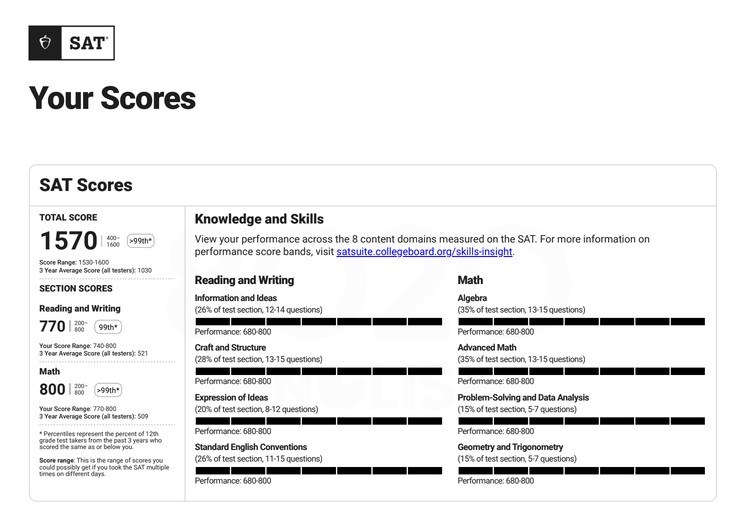
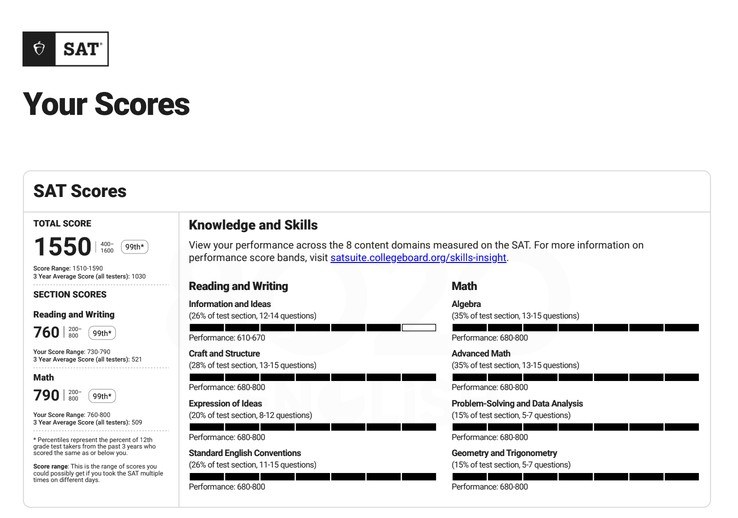

Classes are grouped by placement-test score; a monthly adaptive 2-module mock test, scored on the 400–1600 scale.
111 USD (68 USD registration fee + 43 USD international fee) for on-time registration; late registration adds 38 USD. Source: College Board – International Fees 2026-27.
7 Nov 2026 (deadline 23 Oct), 5 Dec 2026 (deadline 20 Nov), 6 Mar 2027 (deadline 19 Feb), 1 May 2027 (deadline 16 Apr), 5 Jun 2027 (deadline 21 May). The late deadline is about 4 days after the regular deadline. Source: SAT Dates and Deadlines.
13–16 days on the 2026-27 calendar: test on 7 Nov, scores on 20 Nov; test on 5 Dec, scores on 18 Dec; test on 6 Mar 2027, scores on 19 Mar 2027; test on 5 Jun 2027, scores on 21 Jun 2027. Source: Score Release Dates.
Not required: in Vietnam the College Board accepts a valid Vietnamese citizen ID card or a valid passport (original; electronic ID not accepted). If you travel to another country to test, a passport is required. Source: SAT ID Requirements.
1400 is at the 93rd percentile (user group) and 1500 at the 97th; only 9% of the graduating class of 2026 scored 1400–1600. The class of 2026 average was 1045. Source: College Board percentiles + Annual Report 2026.
No. Wrong and blank answers both score 0; scaled scores are calculated using IRT, so answer everything. Source: Assessment Framework for the Digital SAT Suite.
Yes, throughout the Math section: Desmos built into Bluebook or an approved handheld calculator; calculators with CAS are prohibited. No calculators in Reading and Writing. Source: SAT Calculator Policy.
Windows/Mac laptop, iPad, Windows tablet or school-managed Chromebook with Bluebook installed; no phones or personal Chromebooks. Source: SAT Device Readiness.
No limit on attempts; Score Choice lets you choose which test dates to send, but some universities require all scores. 4 free score reports if chosen within 9 days after the test. Source: College Board Help Center, Score Choice.
At some universities, each with its own rules — e.g. VNU University of Engineering and Technology 2026 accepts SAT certificates valid for 2 years from the test date. Source: the university's 2026 admissions information.
The international SAT is taken at test centres authorised by the College Board; see the list and each centre's schedule in the Exam schedule, fees and rules section above. Register early, as seats in Vietnam often run out before the deadline.
Most students start in Grade 10 or early Grade 11 so they have 2–3 attempts before applying. Starting earlier is fine if your English is already solid, around IELTS 6.5 or above.
It depends on the university: top US universities typically see many applications at 1500+, while many other good universities are around 1300–1450. 8020 advises on your target based on the list of universities you are aiming for.
A shorter test that adapts by module: do well in module 1 and module 2 is harder but unlocks higher scores. You need to practise on the actual Bluebook interface and get used to Desmos.
Small groups by score milestone (Foundation · 1200+ · 1400+) and 1-on-1 · 1-on-2 tutoring. Start with a free entry test in the Bluebook format, then practise more on SAT8020 and sit a simulated test every month.
The articles below are currently available in Vietnamese only.
Tỉ trọng 8 miền kiến thức được công bố, cụm dạng ra dày đo được từ đề recall — học tủ SAT có cơ sở khác lộ đề.
SATLộ trình SAT 1500 cho học sinh Việt Nam: 3 giai đoạn và mốc đoChia 3 giai đoạn, mỗi giai đoạn một trọng tâm và một tín hiệu chuyển — đo bằng điểm từng miền kiến thức, không đoán mò.
SATBluebook — app thi SAT chính thức: cài đặt, thi thử và công cụApp thi chính thức của College Board: đề practice full, Desmos gắn sẵn, đánh dấu câu — cài thế nào và luyện sao cho đúng.
SAT VerbalSAT Central Ideas and Details: cách tách ý chính khỏi chi tiết hỗ trợMổ một câu thật: vì sao đáp án đúng thắng, vì sao 3 đáp án nhiễu hấp dẫn — kèm quy trình 5 bước áp dụng ngay.
SATĐề thi SAT: cấu trúc, nguồn đề đáng tin và vì sao nên làm online98 câu/134 phút, 2 phần × 2 module thích ứng. Nguồn đề Bluebook + kho làm online giải tiếng Việt.
SAT MathSAT Advanced Math: bậc hai chứa tham số, hàm mũ và chỗ hay mất điểmChiếm ~35% phần Toán. Mổ một câu tham số thật từng bước — và vì sao 3 đáp án nhiễu đều là sản phẩm của lỗi tính đúng quy trình.
Take the free placement test and 8020 will pinpoint your gaps and place you in the right class with the right teacher. Mock tests with 2 adaptive modules, as in Bluebook, scored on the 400–1600 scale.