Cambridge IGCSE & A-Level — subject-by-subject tuition with PhD and Master's teachers
IGCSE and A-Level are two consecutive stages of the Cambridge pathway: IGCSE is the foundation in Grades 9–10, and A-Level is the entry standard for universities in the UK and other countries that follow the British system.
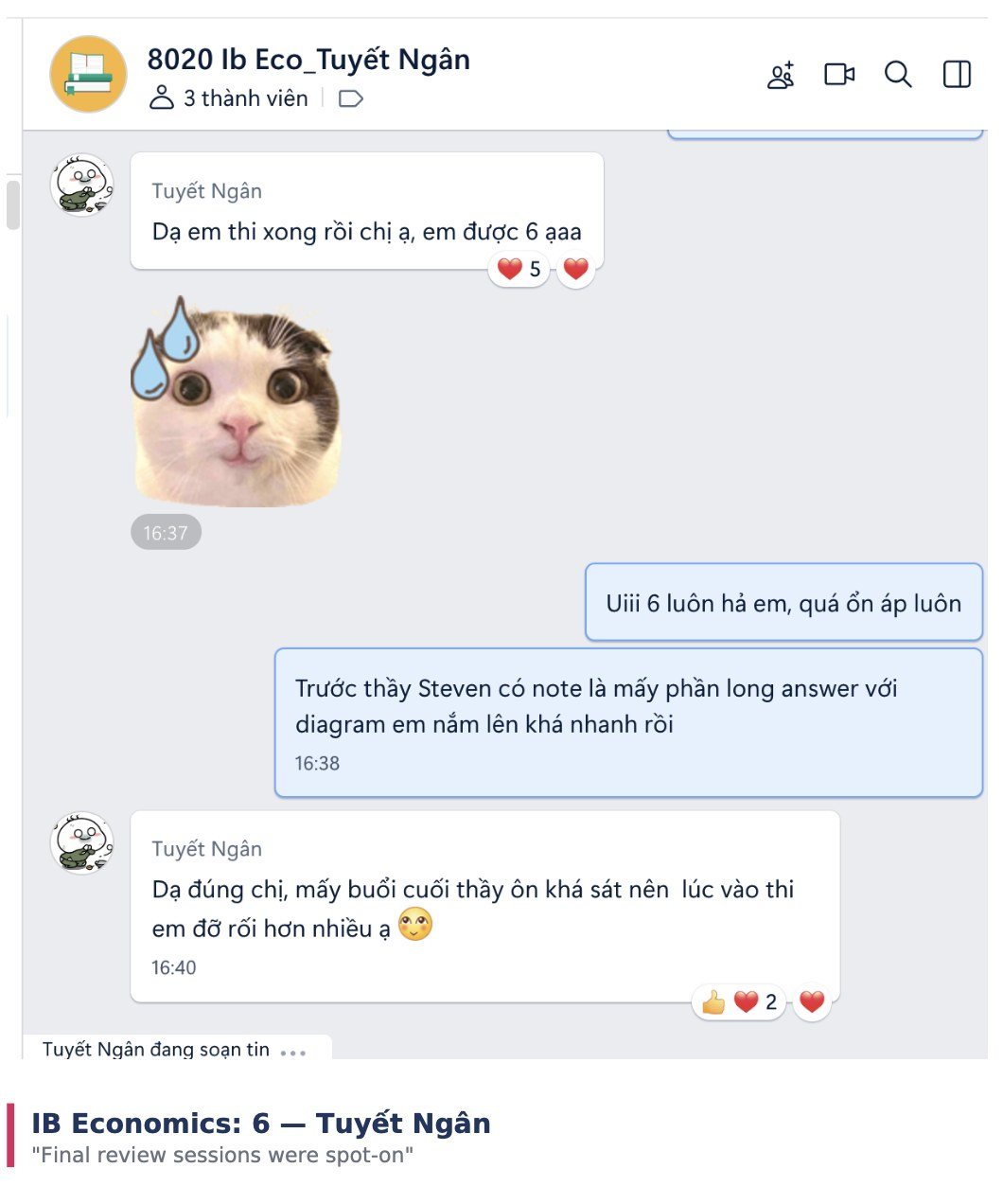
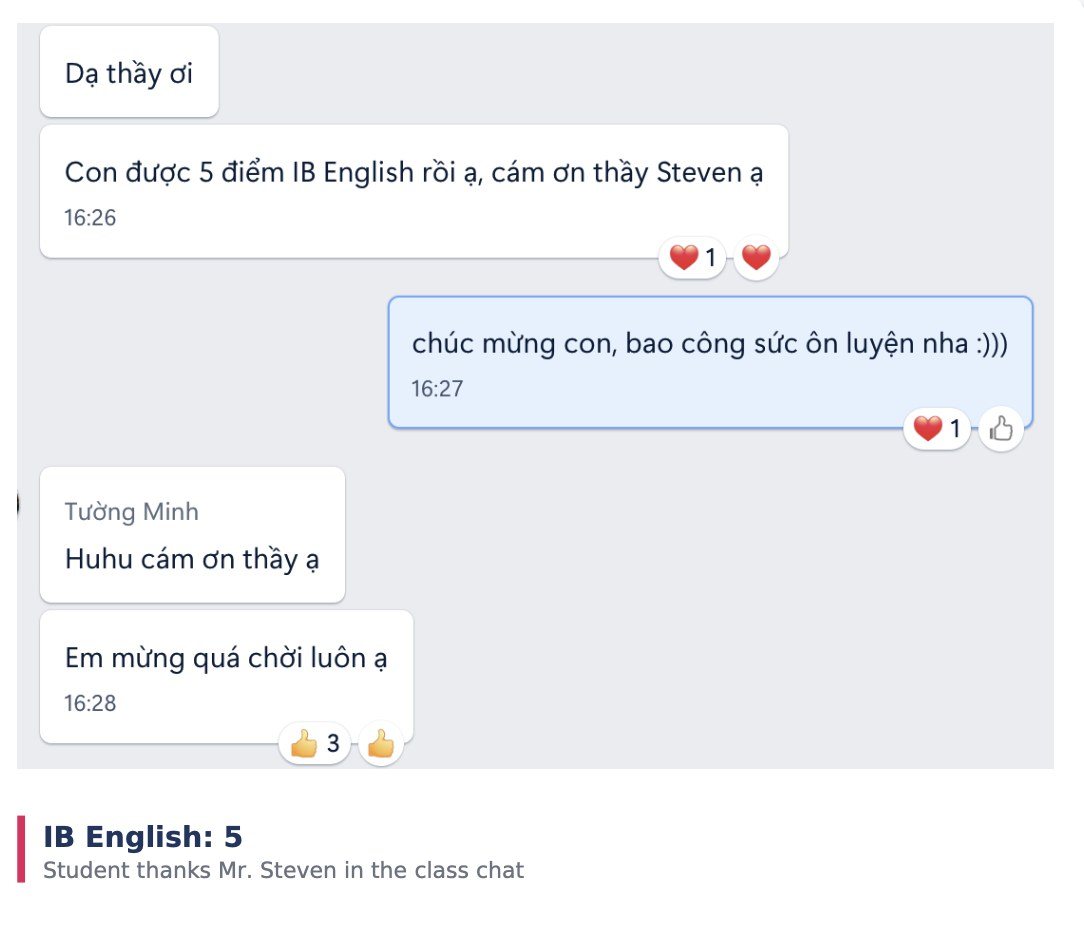
Real scores · Real teachers · Real results — teachers hold at least IELTS 8.0 or SAT 1500, and international programmes are taught by PhD and Master's holders.
The Cambridge (IGCSE · A-Level) exam — what you need to know
IGCSE
Students usually take 5–9 subjects over the two years of Grades 9–10. Graded A*–G or 9–1 depending on the exam board.
A-Level
In-depth study of 3–4 subjects over two years: AS Level in the first year, A2 in the second. Graded A*–E.
How it is marked
Written exams sat paper by paper and marked against a published mark scheme — know the mark scheme and you know where the marks are.
Exam dates
Two main series a year: May–June and October–November.
Who should study
Students at British-curriculum international schools, or students aiming for universities in the UK, Australia, Singapore or Hong Kong.
Videos from 8020 classes
Clips from real 8020 classes and lessons — click to watch right here.
IGCSE and A-Level subjects taught at 8020 — syllabus, paper structure and mark scheme
Click each subject to see the syllabus content, the structure of each paper and how it is marked under the Cambridge mark scheme.
IGCSE · Maths 2 subjects
IGCSE Additional MathematicsStructured and unstructured questions; calculators are NOT allowed.
Exam structure
Paper 1 — Non-calculator · 2h · 80 marks · 50%
Structured and unstructured questions; calculators are NOT allowed.
Paper 2 — Calculator · 2h · 80 marks · 50%
Same format; a scientific calculator is required.
Total 4 hours (two papers) · Paper 1 is non-calculator; Paper 2 requires a scientific calculator. This subject is graded A*–E only — there is no Core tier.
Syllabus — 6 unit
Logarithmic and exponential functions
Functions
Quadratic functions
Indices, surds and polynomials
Circular measure and trigonometry
Differentiation and integration
Written-response section
Calculus questions4–8 marks
Differentiation, integration, maxima and minima, rates of change — the bridge to A Level Mathematics.
Advanced algebra questions4–8 marks
Polynomials, logarithms and exponentials, binomials, matrices, vectors.
"Show that" questions / trigonometric proofsBy point
The marks lie entirely in the steps of the working.
How examiners mark
The mark scheme awards marks STEP BY STEP and applies ecf (error carried forward): a slip at one step does not cost you the marks for later steps, as long as you work correctly with the wrong value.
The command word sets the level of answer required: state · describe (say what happens) · explain (give the REASON) · suggest (apply to an unfamiliar situation) · calculate · compare.
The mark printed beside a question is the number of POINTS you need to make — a [3] question requires three separate points.
Calculation questions must show the working and the UNITS; IGCSE papers often award a separate mark for the unit.
This is the bridging subject to A Level: step-by-step working (M–A) is marked far more strictly than in 0580.
Keep exact form (surds, π, fractions) when the question does not ask for a decimal — rounding early costs marks.
IGCSE MathematicsStructured questions and unstructured questions; calculators are NOT…
Exam structure
Paper 1 — Non-calculator (Core) · 1h30 · 80 marks · 50%
Structured questions and unstructured questions; calculators are NOT allowed.
Paper 3 — Calculator (Core) · 1h30 · 80 marks · 50%
Same question types; a scientific calculator is required.
Paper 2 — Non-calculator (Extended) · 2h · 100 marks · 50%
Extended content; calculators are NOT allowed.
Paper 4 — Calculator (Extended) · 2h · 100 marks · 50%
Extended content; a scientific calculator is required.
Total Core 3 hours (Paper 1 + 3) · Extended 4 hours (Paper 2 + 4) · NO calculator is allowed in Paper 1 and Paper 2; a scientific calculator is required for Paper 3 and Paper 4. Core is graded C–G, Extended A*–E.
Syllabus — 9 unit
Number
Algebra and graphs
Coordinate geometry
Geometry
Mensuration
Trigonometry
Transformations and vectors
Probability
Statistics
Written-response section
Structured questions2–6 marks
Split into (a)(b)(c), with later parts using earlier results.
Unstructured questions4–8 marks
The question gives only a scenario and candidates choose their own approach — the part that most separates the top scorers in the new format.
"Show that" questionsBy point
The result is given; the marks lie entirely in the steps.
How examiners mark
The mark scheme awards marks STEP BY STEP and applies ecf (error carried forward): a slip at one step does not cost you the marks for later steps, as long as you work correctly with the wrong value.
The command word sets the level of answer required: state · describe (say what happens) · explain (give the REASON) · suggest (apply to an unfamiliar situation) · calculate · compare.
The mark printed beside a question is the number of POINTS you need to make — a [3] question requires three separate points.
Calculation questions must show the working and the UNITS; IGCSE papers often award a separate mark for the unit.
Non-calculator papers put heavy weight on working: you must write out the hand-calculation steps — going straight to the answer loses the method marks.
Round to 3 significant figures unless the question says otherwise; give monetary answers to 2 decimal places.
Paper 3 (Core) or Paper 4 (Extended) — Theory · 1h15 · 80 marks · 50%
Short-answer and structured questions.
Paper 5 — Practical Test · 1h15 · 40 marks · 20%
A real hands-on experiment. Schools choose Paper 5 OR Paper 6, not both.
Paper 6 — Alternative to Practical · 1h · 40 marks · 20%
A written paper in place of the practical, testing the same practical skills.
Total 3 hours 15 minutes (Paper 1/2 + 3/4 + 5) or 3 hours (if you take Paper 6) · A scientific calculator may be used in every paper. Cambridge offers two tiers: CORE candidates can only be awarded grades C–G, while EXTENDED candidates also study the Supplement content and can be awarded up to A*. The school decides the tier, but students need to know which one they are on, because the papers and the grade ceiling are very different.
Syllabus — 9 unit
Plant Nutrition: Photosynthesis
Human Nutrition
Transport in Plants and Animals
Diseases and Immunity
Gas Exchange and Respiration
Excretion, Homeostasis and Coordination
Reproduction in Plants and Humans
Inheritance, Variation and Selection
Organisms and Their Environment, Human Influences and Biotechnology
Written-response section
Structured questions (Paper 3/4)By point
Split into parts (a)(b)(c), with table-reading, graph-reading, explanation and calculation questions.
Paper 5 — Practical Test40 marks
A real hands-on experiment: measure, record in a table, plot a graph, comment and suggest improvements.
Paper 6 — Alternative to Practical40 marks
No experiment is carried out, but you answer as if you had just done one: reading instruments, processing data, identifying sources of error.
How examiners mark
The mark scheme awards marks STEP BY STEP and applies ecf (error carried forward): a slip at one step does not cost you the marks for later steps, as long as you work correctly with the wrong value.
The command word sets the level of answer required: state · describe (say what happens) · explain (give the REASON) · suggest (apply to an unfamiliar situation) · calculate · compare.
The mark printed beside a question is the number of POINTS you need to make — a [3] question requires three separate points.
Calculation questions must show the working and the UNITS; IGCSE papers often award a separate mark for the unit.
In Biology, "explain" questions usually require you to link structure to function — describing the structure alone only earns "describe" marks.
Data tables need column headings with units; graphs need fully labelled axes, units and evenly spaced scales.
Paper 1 (Core) or Paper 2 (Extended) — Multiple Choice · 45 minutes · 40 marks · 30%
40 four-option multiple-choice questions.
Paper 3 (Core) or Paper 4 (Extended) — Theory · 1h15 · 80 marks · 50%
Short and structured questions, including equations and mole calculations.
Paper 5 — Practical Test · 1h15 · 40 marks · 20%
Real lab work: titration, calorimetry, identifying ions.
Paper 6 — Alternative to Practical · 1h · 40 marks · 20%
A written paper in place of the practical.
Total 3 hours 15 minutes or 3 hours (depending on whether you take Paper 5 or Paper 6) · A scientific calculator may be used; a periodic table is printed with the paper. Cambridge offers two tiers: CORE candidates can only be awarded grades C–G, while EXTENDED candidates also study the Supplement content and can be awarded up to A*. The school decides the tier, but students need to know which one they are on, because the papers and the grade ceiling are very different.
Syllabus — 12 unit
States of Matter
Atoms, Elements and Compounds
Stoichiometry
Electrochemistry
Chemical Energetics
Chemical Reactions: Rate, Reversibility and Redox
Acids, Bases and Salts
The Periodic Table
Metals
Chemistry of the Environment
Organic Chemistry
Experimental Techniques and Chemical Analysis
Written-response section
Structured questions (Paper 3/4)By point
Split into parts (a)(b)(c), with table-reading, graph-reading, explanation and calculation questions.
Paper 5 — Practical Test40 marks
A real hands-on experiment: measure, record in a table, plot a graph, comment and suggest improvements.
Paper 6 — Alternative to Practical40 marks
No experiment is carried out, but you answer as if you had just done one: reading instruments, processing data, identifying sources of error.
How examiners mark
The mark scheme awards marks STEP BY STEP and applies ecf (error carried forward): a slip at one step does not cost you the marks for later steps, as long as you work correctly with the wrong value.
The command word sets the level of answer required: state · describe (say what happens) · explain (give the REASON) · suggest (apply to an unfamiliar situation) · calculate · compare.
The mark printed beside a question is the number of POINTS you need to make — a [3] question requires three separate points.
Calculation questions must show the working and the UNITS; IGCSE papers often award a separate mark for the unit.
Chemical equations must be BALANCED and include state symbols when the question asks for them — miss either one and the mark is lost even if the substances are correct.
Mole calculations: write the formula, substitute the values, include units; round the answer sensibly in line with the data given.
IGCSE Computer ScienceShort and structured questions on Topics 1–6.
Exam structure
Paper 1 — Computer Systems · 1h45 · 75 marks · 50%
Short and structured questions on Topics 1–6 (data, hardware, software, networks, security, ethics).
Paper 2 — Algorithms, Programming and Logic · 1h45 · 75 marks · 50%
Short questions, structured questions and one scenario-based question, on Topics 7–10.
Total 3 hours 30 minutes (two papers) · Calculators are NOT allowed in either paper. There are no Core/Extended tiers — all candidates sit the same papers and are graded A*–G.
Syllabus — 9 unit
Data Representation
Data Transmission
Software
The Internet and Its Uses
Automated and Emerging Technologies
Algorithm Design and Problem-Solving
Programming
Databases
Boolean Logic
Written-response section
Pseudocode and flowchart questions3–8 marks
Write algorithms in pseudocode following Cambridge conventions, or draw a flowchart.
Trace table3–6 marks
Fill in, step by step, how the variables change as a piece of pseudocode runs.
Scenario-based questions12–15 marks
One programming problem: analysis, algorithm design, and writing the program in pseudocode.
Logic questions3–6 marks
Logic circuits, truth tables, logic expressions.
How examiners mark
The mark scheme awards marks STEP BY STEP and applies ecf (error carried forward): a slip at one step does not cost you the marks for later steps, as long as you work correctly with the wrong value.
The command word sets the level of answer required: state · describe (say what happens) · explain (give the REASON) · suggest (apply to an unfamiliar situation) · calculate · compare.
The mark printed beside a question is the number of POINTS you need to make — a [3] question requires three separate points.
Calculation questions must show the working and the UNITS; IGCSE papers often award a separate mark for the unit.
Pseudocode is marked on LOGIC, not on the syntax of any one language; but it must follow the notation set out in the syllabus and be consistent.
Number base conversions (binary, hex, denary) must show the intermediate steps to earn full marks.
Paper 1 (Core) or Paper 2 (Extended) — Multiple Choice · 45 minutes · 40 marks · 30%
40 four-option multiple-choice questions.
Paper 3 (Core) or Paper 4 (Extended) — Theory · 1h15 · 80 marks · 50%
Short and structured questions, with many calculation and graph-reading questions.
Paper 5 — Practical Test · 1h15 · 40 marks · 20%
Real lab work: measuring, drawing up tables, plotting graphs.
Paper 6 — Alternative to Practical · 1h · 40 marks · 20%
A written paper in place of the practical.
Total 3 hours 15 minutes or 3 hours (depending on whether you take Paper 5 or Paper 6) · A scientific calculator may be used; formulae are NOT provided and must be memorised. Cambridge offers two tiers: CORE candidates can only be awarded grades C–G, while EXTENDED candidates also study the Supplement content and can be awarded up to A*. The school decides the tier, but students need to know which one they are on, because the papers and the grade ceiling are very different.
Syllabus — 6 unit
Motion, Forces and Energy
Thermal Physics
Waves
Electricity and Magnetism
Nuclear Physics
Space Physics
Written-response section
Structured questions (Paper 3/4)By point
Split into parts (a)(b)(c), with table-reading, graph-reading, explanation and calculation questions.
Paper 5 — Practical Test40 marks
A real hands-on experiment: measure, record in a table, plot a graph, comment and suggest improvements.
Paper 6 — Alternative to Practical40 marks
No experiment is carried out, but you answer as if you had just done one: reading instruments, processing data, identifying sources of error.
How examiners mark
The mark scheme awards marks STEP BY STEP and applies ecf (error carried forward): a slip at one step does not cost you the marks for later steps, as long as you work correctly with the wrong value.
The command word sets the level of answer required: state · describe (say what happens) · explain (give the REASON) · suggest (apply to an unfamiliar situation) · calculate · compare.
The mark printed beside a question is the number of POINTS you need to make — a [3] question requires three separate points.
Calculation questions must show the working and the UNITS; IGCSE papers often award a separate mark for the unit.
Multi-step calculations are marked step by step: writing the correct formula already earns a mark, so never leave a question blank just because you haven't reached the answer.
Units must be in the correct SI system and the correct multiple (kJ ≠ J, cm ≠ m) — this is the most common way marks are lost in this subject.
IGCSE AccountingMultiple choice covering the whole syllabus.
Exam structure
Paper 1 — Multiple Choice · 1h15 · 35 marks · 30%
Multiple choice covering the whole syllabus.
Paper 2 — Structured Written Paper · 1h45 · 100 marks · 70%
Structured questions covering the whole syllabus.
Total 3 hours (two papers) · A scientific calculator is required. Graded A*–G.
Syllabus — 11 unit
Fundamentals of Accounting
Sources and Recording of Data
Verification of Accounting Records
Adjustments to Financial Statements
Financial Statements of Sole Traders
Partnership Accounts
Limited Company Accounts
Clubs, Societies and Manufacturing Accounts
Incomplete Records
Analysis and Interpretation of Accounts
Accounting Principles and Policies
Written-response section
Double-entry bookkeeping and ledgers5–12 marks
Journal, ledger, trial balance, control account, bank reconciliation.
Preparing financial statements10–20 marks
Income statement and statement of financial position — the right format, the right line labels, the right period.
Year-end adjustments4–10 marks
Depreciation, doubtful debts, prepayments and accruals.
Analysis and comment questions4–8 marks
Calculate the ratio, then comment — you must use the exact figure you have just calculated.
How examiners mark
The mark scheme awards marks STEP BY STEP and applies ecf (error carried forward): a slip at one step does not cost you the marks for later steps, as long as you work correctly with the wrong value.
The command word sets the level of answer required: state · describe (say what happens) · explain (give the REASON) · suggest (apply to an unfamiliar situation) · calculate · compare.
The mark printed beside a question is the number of POINTS you need to make — a [3] question requires three separate points.
Calculation questions must show the working and the UNITS; IGCSE papers often award a separate mark for the unit.
Following the correct FORMAT is part of the marks: a missing statement heading, a missing business name or a missing accounting period each loses marks.
ecf is very generous: a wrong value carried into a later part still earns marks if it is processed correctly — never leave later parts blank.
Comment questions are marked by level of response and must be tied to the data, not written in general terms.
IGCSE Business StudiesFour questions mixing short-answer and data-response items; answer…
Exam structure
Paper 1 — Short Answer and Data Response · 1h30 · 80 marks · 50%
Four questions mixing short-answer and data-response items; answer all four.
Paper 2 — Case Study · 1h30 · 80 marks · 50%
Four questions based on a case study printed with the paper; answer all four.
Total 3 hours (two papers) · A scientific calculator is required — both papers include calculation questions. Graded A*–G.
Syllabus — 6 unit
Understanding Business Activity
People in Business
Marketing
Operations Management
Financial Information and Decisions
External Influences on Business Activity
Written-response section
2-mark question — definition2 marks
Define a term, usually with an example.
4–6-mark questions — explanation4–6 marks
State the point and explain its consequence for the business in the question.
6-mark questions — calculation6 marks
Revenue, costs, profit, break-even point, ratios — show the formula and the currency unit.
12-mark question — evaluation12 marks
Weigh up several options and recommend one, with reasons grounded in the case study data.
How examiners mark
The mark scheme awards marks STEP BY STEP and applies ecf (error carried forward): a slip at one step does not cost you the marks for later steps, as long as you work correctly with the wrong value.
The command word sets the level of answer required: state · describe (say what happens) · explain (give the REASON) · suggest (apply to an unfamiliar situation) · calculate · compare.
The mark printed beside a question is the number of POINTS you need to make — a [3] question requires three separate points.
Calculation questions must show the working and the UNITS; IGCSE papers often award a separate mark for the unit.
The 12-mark question is marked by level of response: knowledge → application to the business in the question → analysis → evaluation and recommendation.
Naming the business in the case study and quoting figures from the paper is the condition for reaching the upper mark levels.
A recommendation must CHOOSE one option; answering "both are good" cannot reach the top level.
IGCSE Economics30 multiple-choice questions; answer all 30.
Exam structure
Paper 1 — Multiple Choice · 45 minutes · 30 marks · 30%
30 multiple-choice questions; answer all 30.
Paper 2 — Structured Questions · 2h15 · 90 marks · 70%
One compulsory source-based question, plus three chosen from the remaining four.
Total 3 hours (two papers) · A scientific calculator may be used. There are no Core/Extended tiers — graded A*–G.
Syllabus — 6 unit
The Basic Economic Problem
The Allocation of Resources
Microeconomic Decision Makers
Government and the Macroeconomy
Economic Development
International Trade and Globalisation
Written-response section
Compulsory source-based question30 marks
Read data tables and a real news extract, then answer a chain of questions running from definition to evaluation.
Optional questions20 marks per question
Split into (a)(b)(c)(d): definition 2 marks · explanation 4 marks · analysis 6 marks · evaluation 8 marks.
8-mark evaluation question8 marks
You need both sides and a conclusion that takes a position; this is what decides the A* in this subject.
How examiners mark
The mark scheme awards marks STEP BY STEP and applies ecf (error carried forward): a slip at one step does not cost you the marks for later steps, as long as you work correctly with the wrong value.
The command word sets the level of answer required: state · describe (say what happens) · explain (give the REASON) · suggest (apply to an unfamiliar situation) · calculate · compare.
The mark printed beside a question is the number of POINTS you need to make — a [3] question requires three separate points.
Calculation questions must show the working and the UNITS; IGCSE papers often award a separate mark for the unit.
Supply-and-demand diagrams need labelled axes, the before and after curves and shift arrows, and must be referred to in your text.
8-mark questions are marked by level of response: listing advantages and disadvantages without reaching a conclusion caps the answer at around 5–6 marks.
Define terms the first time you use them — the 2-mark part (a) is almost always a definition.
A warm-up conversation followed by discussion of a set topic; marked separately and not counted towards the letter grade for the two written papers.
Total about 3 hours (not including Speaking) · No calculator. The Extended tier is graded A*–G; writing is marked on two separate scales, Content and Language.
Syllabus — 6 unit
Reading: skimming, scanning and reading for detail
Note-making and summary writing
Grammar and accuracy in context
Vocabulary, collocation and register
Informal writing: emails and letters
Formal writing: reports, articles and speeches
Written-response section
Exercise 4 — Summary10 marks
Summarise from exactly the angle the question asks for, in continuous prose and in your own words; marked out of 6 for content and 4 for language.
Exercise 5 — Informal writing16 marks
An email or letter to a friend, about 150 words, covering the three bullet points in the task.
Exercise 6 — Formal writing16 marks
A report, article or speech of about 200 words; it needs a signposted structure and specific recommendations.
How examiners mark
Writing is marked on TWO separate scales: Content (did you do everything the task asked?) and Language (accuracy, range, appropriate register). Write beautifully but skip one bullet point, and you still lose all the content marks for that bullet.
‘Off-task’ means not addressing the task, not making grammar mistakes — it is the heaviest penalty and almost always comes from missing one requirement in the prompt.
Exercise 4 requires ‘own words’: copying whole sentences from the text loses language marks even if the content is right.
Register earns marks: an informal letter calls for contractions and phrasal verbs; a report calls for an impersonal voice and no rhetorical questions. Mixing the two registers in one piece is an error named in the mark scheme.
Reading is marked on meaning, not wording: the right idea in different words still earns the mark, but copying a whole sentence that carries extra incorrect information loses it.
Exceeding the word range is not penalised directly, but an overly long answer usually brings language errors and repeated ideas with it.
A-Level Computer ScienceContent from topics 1–8. 50% of AS Level · 25% of A Level.
Exam structure
Paper 1 — Theory Fundamentals · 1h30 · 75 marks
Content from topics 1–8 (data, hardware, networks, security, ethics, databases). 50% of AS Level · 25% of A Level.
Paper 2 — Fundamental Problem-solving and Programming Skills · 2h · 75 marks
Topics 9–12; answers written in PSEUDOCODE. 50% of AS Level · 25% of A Level.
Paper 3 — Advanced Theory · 1h30 · 75 marks
Topics 13–20. 25% of A Level.
Paper 4 — Practical · 2h30 · 75 marks
Sat ON A COMPUTER with no internet access: submit complete source code and evidence of testing, in Java, Visual Basic or Python (console mode). 25% of the A Level.
Total AS Level 3 hours 30 minutes · A Level 7 hours 30 minutes · Calculators are NOT allowed in any paper. Paper 4 is taken on a computer with a compiler installed.
Syllabus — 10 unit
Data Representation: Number Bases, Binary Arithmetic and Character Sets
Communication
Logic Gates and Boolean Algebra
Hardware and Processor Fundamentals
Databases and Data Security
Algorithms and Data Structures
Recursion, OOP and File Handling
Operating Systems, Networks and AI
Floating Point, Compression and Software Development
Advanced Architecture, Networks and Computational Thinking
Written-response section
Paper 2 — pseudocode questionBy point
Write algorithms in pseudocode following Cambridge conventions; the logic is marked, not the syntax of any one language.
Trace table questionsBy point
Fill in each step of the variable changes; one wrong row loses only that row, but a blank loses everything.
Paper 4 — programming task75 marks
Write a working program, with screenshots of test runs using the data given in the question.
How examiners mark
Cambridge's mark scheme awards marks STEP BY STEP: M (correct method) · A (correct answer) · B (independent mark). A slip in the middle of a solution does not cost you the marks for later steps, thanks to ecf (error carried forward) — provided the later steps are done correctly with the wrong value.
The command word sets the level of answer required: state (give) · describe (say what happens) · explain (give the REASON / mechanism) · suggest (apply to an unfamiliar situation) · compare (both sides must appear in one sentence) · evaluate (weigh both sides, then conclude). Correct knowledge pitched at the wrong level for the command word scores nothing.
Calculation questions must show the formula, the substitution, the UNITS and a sensible number of significant figures (usually 3 significant figures).
The mark printed beside a question is the number of POINTS you need to make: a [3] question requires three separate points, and one very long point cannot stand in for three.
Pseudocode must follow the notation in the syllabus appendix (DECLARE, FOR…NEXT, WHILE…ENDWHILE) — mixing in Python syntax loses marks.
Paper 4 also marks TESTING EVIDENCE: a correct program submitted without screenshots of the test runs loses that whole set of marks.
A-Level Mathematics10–12 structured questions. 60% of AS Level · 30% of A Level.…
Exam structure
Paper 1 — Pure Mathematics 1 · 1h50 · 75 marks
10–12 structured questions. 60% of AS Level · 30% of A Level. Compulsory for both AS and A Level.
Paper 2 — Pure Mathematics 2 · 1h15 · 50 marks
6–8 questions. 40% of AS Level — taken only on the AS Level route.
Paper 3 — Pure Mathematics 3 · 1h50 · 75 marks
9–11 questions. 30% of A Level. Compulsory for A Level.
Paper 4 — Mechanics · 1h15 · 50 marks
6–8 Mechanics questions. 40% of AS Level · 20% of A Level.
Paper 5 — Probability & Statistics 1 · 1h15 · 50 marks
6–8 questions. 40% of AS Level · 20% of A Level.
Paper 6 — Probability & Statistics 2 · 1h15 · 50 marks
6–8 questions. 20% of A Level — A Level only.
Total Depends on the combination of papers the school chooses: A Level is usually Paper 1 + 3 + two applied papers (4 & 5, or 5 & 6). · A scientific calculator is required in every paper (graphing calculators with stored programs are not allowed).
Syllabus — 7 unit
Pure Mathematics 130%
Pure Mathematics — Further Pure
Vectors and Differential Equations
Complex Numbers
Mechanics20%
Probability & Statistics 120%
Probability & Statistics — Further20%
Written-response section
Structured questions4–10 marks per question
Split into (i)(ii)(iii); later parts usually use earlier results, so leaving the first part blank costs you the whole chain.
"Show that" / "Prove" questionsBy point
The result is already printed in the question — the marks lie ENTIRELY in the steps, and skipping steps scores 0.
Applied questions (Mechanics / Statistics)By point
Set up the model first: draw the force diagram, or state the distribution and its parameters, and only then calculate.
How examiners mark
Cambridge's mark scheme awards marks STEP BY STEP: M (correct method) · A (correct answer) · B (independent mark). A slip in the middle of a solution does not cost you the marks for later steps, thanks to ecf (error carried forward) — provided the later steps are done correctly with the wrong value.
The command word sets the level of answer required: state (give) · describe (say what happens) · explain (give the REASON / mechanism) · suggest (apply to an unfamiliar situation) · compare (both sides must appear in one sentence) · evaluate (weigh both sides, then conclude). Correct knowledge pitched at the wrong level for the command word scores nothing.
Calculation questions must show the formula, the substitution, the UNITS and a sensible number of significant figures (usually 3 significant figures).
The mark printed beside a question is the number of POINTS you need to make: a [3] question requires three separate points, and one very long point cannot stand in for three.
Answers are rounded to 3 significant figures unless the question says otherwise; keep full accuracy in intermediate steps and round only at the final step.
In Mechanics questions, most marks are lost on force diagrams with missing forces (normal reaction, friction), not on the calculations.
A-Level Biology40 multiple-choice questions on AS content. 31% of AS Level · 15.5%…
Exam structure
Paper 1 — Multiple Choice · 1h15 · 40 marks
40 multiple-choice questions on AS content. 31% of AS Level · 15.5% of A Level.
Paper 2 — AS Level Structured Questions · 1h15 · 60 marks
Structured questions on AS content. 46% of AS Level · 23% of A Level.
Paper 3 — Advanced Practical Skills · 2h · 40 marks
Carry out a real experiment and answer the accompanying questions. 23% of AS Level · 11.5% of A Level.
Paper 4 — A Level Structured Questions · 2h · 100 marks
A Level content, with some AS knowledge reused. 38.5% of A Level.
Paper 5 — Planning, Analysis and Evaluation · 1h15 · 30 marks
Designing experiments, then processing and evaluating data; contexts may lie outside the syllabus. 11.5% of the A Level.
Total AS Level 4 hours 30 minutes (Paper 1–3) · A Level 7 hours 45 minutes (all 5 papers) · A scientific calculator may be used in every paper.
Syllabus — 12 unit
Cell Structure
Biological Molecules
Enzymes
Cell Membranes and Transport
The Mitotic Cell Cycle
Nucleic Acids and Protein Synthesis
Transport in Plants and Mammals
Gas Exchange, Infectious Disease and Immunity
Energy and Respiration
Photosynthesis
Homeostasis and Control and Coordination
Inheritance
Written-response section
Paper 2 / Paper 4 — structured questionBy point
Split into parts (a)(b)(c), each with its own command word; usually includes table-reading, graph-reading and reasoning questions.
Paper 3 — practical skills40 marks
Collect data, set out a table in the correct format, plot a graph, and answer a question on improving the experiment.
Paper 5 — experiment design30 marks
State the independent, dependent and control variables, the measurement method, the data processing and your concluding remarks.
How examiners mark
Cambridge's mark scheme awards marks STEP BY STEP: M (correct method) · A (correct answer) · B (independent mark). A slip in the middle of a solution does not cost you the marks for later steps, thanks to ecf (error carried forward) — provided the later steps are done correctly with the wrong value.
The command word sets the level of answer required: state (give) · describe (say what happens) · explain (give the REASON / mechanism) · suggest (apply to an unfamiliar situation) · compare (both sides must appear in one sentence) · evaluate (weigh both sides, then conclude). Correct knowledge pitched at the wrong level for the command word scores nothing.
Calculation questions must show the formula, the substitution, the UNITS and a sensible number of significant figures (usually 3 significant figures).
The mark printed beside a question is the number of POINTS you need to make: a [3] question requires three separate points, and one very long point cannot stand in for three.
Paper 5 is where the most marks are lost needlessly: leave out a control variable, or fail to say HOW the dependent variable is measured, and that whole set of marks is gone.
Data tables need column headings with units in the form "quantity / unit", and a consistent number of decimal places within each column.
A-Level Chemistry40 multiple-choice questions on AS content. 31% of AS Level · 15.5%…
Exam structure
Paper 1 — Multiple Choice · 1h15 · 40 marks
40 multiple-choice questions on AS content. 31% of AS Level · 15.5% of A Level.
Paper 2 — AS Level Structured Questions · 1h15 · 60 marks
Structured questions on AS content. 46% of AS Level · 23% of A Level.
Paper 3 — Advanced Practical Skills · 2h · 40 marks
Real lab work: titration, qualitative observation, data processing. 23% of the AS Level · 11.5% of the A Level.
Paper 4 — A Level Structured Questions · 2h · 100 marks
A Level content, reusing AS knowledge. 38.5% of A Level.
Paper 5 — Planning, Analysis and Evaluation · 1h15 · 30 marks
Designing, analysing and evaluating experiments. 11.5% of the A Level.
Total AS Level 4 hours 30 minutes · A Level 7 hours 45 minutes · A scientific calculator may be used in every paper; a Data Booklet (periodic table, constants, electrode potentials) is printed with the paper.
Syllabus — 9 unit
Atomic Structure
Atoms, Molecules & Stoichiometry
Chemical Bonding
States of Matter
Chemical Energetics
Electrochemistry
Chemical Equilibria
Reaction Kinetics
Periodicity and Group 2
Written-response section
Quantitative calculation questionsBy point
Moles, concentration, titration, thermochemistry, equilibrium constants, pH, electrochemistry — always show your working and units.
Organic mechanism questionsBy point
Draw curly arrows from the correct electron source, and state the reaction type and conditions.
Paper 3 — titration and observation40 marks
Record readings to the precision of the apparatus; average the concordant titres.
Paper 5 — experiment design30 marks
Variables, measuring instruments and their precision, how to process the data, sources of error and how to reduce them.
How examiners mark
Cambridge's mark scheme awards marks STEP BY STEP: M (correct method) · A (correct answer) · B (independent mark). A slip in the middle of a solution does not cost you the marks for later steps, thanks to ecf (error carried forward) — provided the later steps are done correctly with the wrong value.
The command word sets the level of answer required: state (give) · describe (say what happens) · explain (give the REASON / mechanism) · suggest (apply to an unfamiliar situation) · compare (both sides must appear in one sentence) · evaluate (weigh both sides, then conclude). Correct knowledge pitched at the wrong level for the command word scores nothing.
Calculation questions must show the formula, the substitution, the UNITS and a sensible number of significant figures (usually 3 significant figures).
The mark printed beside a question is the number of POINTS you need to make: a [3] question requires three separate points, and one very long point cannot stand in for three.
Curly arrows must start from a lone pair or from a bond — drawing one from an atom loses the mark even if the product is correct.
The number of significant figures in your answer must match the least precise data; a burette is read to 0.05 cm³.
A-Level Physics40 multiple-choice questions on AS content. 31% of AS Level · 15.5%…
Exam structure
Paper 1 — Multiple Choice · 1h15 · 40 marks
40 multiple-choice questions on AS content. 31% of AS Level · 15.5% of A Level.
Paper 2 — AS Level Structured Questions · 1h15 · 60 marks
Structured questions on AS content. 46% of AS Level · 23% of A Level.
Paper 3 — Advanced Practical Skills · 2h · 40 marks
Two compulsory questions: taking measurements, drawing up tables, plotting graphs, calculating uncertainties. 23% of the AS Level · 11.5% of the A Level.
Paper 4 — A Level Structured Questions · 2h · 100 marks
A Level content, reusing AS knowledge. 38.5% of A Level.
Paper 5 — Planning, Analysis and Evaluation · 1h15 · 30 marks
Experimental design and data analysis; contexts may be outside the syllabus. 11.5% of the A Level.
Total AS Level 4 hours 30 minutes · A Level 7 hours 45 minutes · A scientific calculator may be used in every paper; a Data and Formulae booklet is printed with the paper.
Syllabus — 10 unit
Physical Quantities, Units and Kinematics
Dynamics, Newton's Laws and Momentum
Forces, Density, Pressure and Deformation
Thermal Physics and Ideal Gases
Particle, Quantum and Nuclear Physics
Work, Energy and Power
Waves and Superposition
Electricity and D.C. Circuits
Circular Motion, Gravitational Fields and Oscillations
Electric Fields, Capacitance and Magnetic Fields
Written-response section
Physical reasoning questionsBy point
Explain a phenomenon using a law — naming the law is not enough; you must say how it leads to the result.
Calculation questionsBy point
Choosing the formula, substituting values, SI units and significant figures; multi-step calculations are marked step by step.
Paper 3 — measurement and graphs40 marks
Set out tables in the correct format, draw graphs that fill more than half the grid, calculate the gradient from two widely separated points, estimate uncertainties.
Paper 5 — experiment design30 marks
Variables, the set-up diagram, how to take measurements, how to linearise the relationship to plot a straight-line graph, and safety precautions.
How examiners mark
Cambridge's mark scheme awards marks STEP BY STEP: M (correct method) · A (correct answer) · B (independent mark). A slip in the middle of a solution does not cost you the marks for later steps, thanks to ecf (error carried forward) — provided the later steps are done correctly with the wrong value.
The command word sets the level of answer required: state (give) · describe (say what happens) · explain (give the REASON / mechanism) · suggest (apply to an unfamiliar situation) · compare (both sides must appear in one sentence) · evaluate (weigh both sides, then conclude). Correct knowledge pitched at the wrong level for the command word scores nothing.
Calculation questions must show the formula, the substitution, the UNITS and a sensible number of significant figures (usually 3 significant figures).
The mark printed beside a question is the number of POINTS you need to make: a [3] question requires three separate points, and one very long point cannot stand in for three.
Paper 5 puts heavy weight on LINEARISATION: you must state clearly which quantity is plotted against which, and what the gradient represents.
Graphs: the plotted points must occupy at least half the grid along both axes; a hand-drawn line must have the points balanced on either side.
A-Level AccountingMultiple choice on the content of sections 1–2. 30% of the AS Level…
Exam structure
Paper 1 — Multiple Choice · 1h15 · 35 marks
Multiple choice on the content of sections 1–2. 30% of the AS Level · 14% of the A Level.
Paper 2 — Fundamentals of Accounting · 1h45 · 100 marks
Four structured questions on Sections 1–2 content. 70% of AS Level · 36% of A Level.
Paper 3 — Financial Accounting · 1h30 · 75 marks
Three structured questions on Section 3 content. 30% of A Level.
Paper 4 — Cost and Management Accounting · 1h · 50 marks
Two structured questions on Section 4 content. 20% of the A Level.
Total AS Level 3 hours · A Level 5 hours 30 minutes · A scientific calculator is required.
Syllabus — 10 unit
The Accounting Cycle, Double Entry & Books of Prime Entry
Business Entities: Sole Traders, Partnerships and Limited Companies
Accounting for Non-current Assets
Reconciliation and Verification
Cost and Management Accounting
Analysis of Financial Statements
Partnership and Company Accounts
Budgeting and Standard Costing
Cash Flows, Concepts and Incomplete Records
Manufacturing, Costing Methods and Investment Appraisal
Written-response section
Preparing financial statements10–20 marks
Income statement, statement of financial position, statement of changes in equity — in the correct FORMAT and with the correct line labels.
Journal entries and ledgers5–12 marks
Journal, ledger, control account, bank reconciliation, year-end adjustments.
Cost and management accounting10–20 marks
Marginal vs absorption costing, budgeting, variance analysis, investment decisions.
Comment questions4–8 marks
Read the financial ratios, then make a recommendation — it must be tied to the figures just calculated, not stated in general terms.
How examiners mark
Cambridge's mark scheme awards marks STEP BY STEP: M (correct method) · A (correct answer) · B (independent mark). A slip in the middle of a solution does not cost you the marks for later steps, thanks to ecf (error carried forward) — provided the later steps are done correctly with the wrong value.
The command word sets the level of answer required: state (give) · describe (say what happens) · explain (give the REASON / mechanism) · suggest (apply to an unfamiliar situation) · compare (both sides must appear in one sentence) · evaluate (weigh both sides, then conclude). Correct knowledge pitched at the wrong level for the command word scores nothing.
Calculation questions must show the formula, the substitution, the UNITS and a sensible number of significant figures (usually 3 significant figures).
The mark printed beside a question is the number of POINTS you need to make: a [3] question requires three separate points, and one very long point cannot stand in for three.
Following the correct format is part of the marks: lines in the wrong order, a missing statement heading or a missing accounting period all lose marks.
ecf is very generous in this subject — a wrong value carried into a later part still earns marks if it is processed correctly, so you must NOT leave later parts blank.
"Comment"/"advise" questions are marked by level of response: you must use the figures you have just calculated and state the limitations of the ratios.
A-Level BusinessSection A: four short-answer questions; Section B: one essay chosen…
Exam structure
Paper 1 — Business Concepts 1 · 1h15 · 40 marks
Section A: four short-answer questions (the first three have two parts); Section B: one essay chosen from two, each in two parts. 40% of AS Level · 20% of A Level.
Paper 2 — Business Concepts 2 · 1h30 · 60 marks
Two data-response questions, six parts each. 60% of the AS Level · 30% of the A Level.
Paper 3 — Business Decision-Making · 1h45 · 60 marks
Five questions based on one case study. 30% of A Level.
Paper 4 — Business Strategy · 1h15 · 40 marks
Two essays based on a case study. 20% of the A Level.
Total AS Level 2 hours 45 minutes · A Level 5 hours 45 minutes · A scientific calculator is required — Paper 2 and Paper 3 always include financial calculation questions.
Syllabus — 10 unit
Enterprise, Business Structure and Size
Business Objectives and Stakeholders
Human Resource Management
Marketing
Operations Management
Finance and Accounting
Strategic Management
The External Environment and Business Ethics
Growth, Objectives and Business Planning
Project Management, Data and Sustainability
Written-response section
Short questions with command words2–5 marks
Define · briefly explain · calculate — answer concisely, making exactly as many points as the marks shown beside the question.
12-mark evaluation question12 marks
Marked by level of response: knowledge → application to the business in the question → analysis → evaluation with a conclusion.
Paper 4 essay20 marks each
Strategy discussion based on the case study: apply tools (SWOT, Ansoff, Porter, decision matrix) to the actual data in the paper.
Finance calculation questions3–6 marks
Break-even point, margin of safety, discounted cash flow, financial ratios — state the formula and the currency unit.
How examiners mark
Extended-response questions are marked by LEVEL OF RESPONSE (band descriptors), not by adding up points: the examiner first places the answer in a level, then chooses a mark within that level. Moving up a level takes analysis of cause-and-effect chains and evaluation, not a longer answer.
Evaluation must be tied to the context of the case in the question and end with a conclusion that takes a position and states its conditions ("it depends on…") — listing pros and cons and leaving it open caps the mark.
Application is the most neglected level: you must name the business in the question and quote its figures, otherwise the answer stalls at "knowledge + generic analysis".
A wrong calculation that shows the formula and the working still keeps the method marks (ecf).
A-Level Economics30 multiple-choice questions on AS content. 33% of AS Level · 17% of…
Exam structure
Paper 1 — AS Level Multiple Choice · 1h · 30 marks
30 multiple-choice questions on AS content. 33% of AS Level · 17% of A Level.
Paper 2 — AS Level Data Response and Essays · 2h · 60 marks
Section A: one data response question (20 marks); Section B: one microeconomics essay chosen from two, in two parts (20 marks); Section C: one macroeconomics essay chosen from two, in two parts (20 marks). 67% of AS Level · 33% of A Level.
Paper 3 — A Level Multiple Choice · 1h15 · 30 marks
30 multiple-choice questions on A Level content. 17% of A Level.
Paper 4 — A Level Data Response and Essays · 2h · 60 marks
Same three sections as Paper 2, but the two essays are NOT divided into parts — candidates build their own structure. 33% of A Level.
Total AS Level 3 hours · A Level 6 hours 15 minutes · A scientific calculator may be used; Paper 2 and Paper 4 always include calculations from data tables.
Syllabus — 9 unit
Scarcity, Choice and Resource Allocation
Elasticity of Demand and Supply
Demand, Supply, Market Equilibrium and Surplus
Costs, Revenue and the Theory of the Firm
Market Structure and the Behaviour of Firms
National Income, Economic Growth and the AD-AS Model
Inflation, Unemployment, Money and the Business Cycle
Fiscal and Monetary Policy
International Trade, Exchange Rates and the Balance of Payments
Written-response section
Data response (20 marks)20 marks
Short definition and calculation questions, then one extended evaluation question that must QUOTE FIGURES from the source material.
Essay in parts (AS, Paper 2)20 marks
(a) explain, 8 marks; (b) evaluate, 12 marks — part (b) is what decides the mark for the whole answer.
Essay without parts (A Level, Paper 4)20 marks
There are no prompts to structure the answer: the essay must supply its own introduction, an analytical body with diagrams, and a conclusion that takes a position.
How examiners mark
Extended-response questions are marked by LEVEL OF RESPONSE (band descriptors), not by adding up points: the examiner first places the answer in a level, then chooses a mark within that level. Moving up a level takes analysis of cause-and-effect chains and evaluation, not a longer answer.
Evaluation must be tied to the context of the case in the question and end with a conclusion that takes a position and states its conditions ("it depends on…") — listing pros and cons and leaving it open caps the mark.
DIAGRAMS are a major source of marks: include a title, labels on both axes, the before and after curves, and shift arrows — and they must be REFERRED TO in your text; a diagram that is drawn and then left alone earns no analysis marks.
Terms must be defined on first use (elasticity, opportunity cost, market failure…).
Evaluation questions must state what the outcome depends on (elasticity, time lags, short run/long run) — this is the line between a good answer and the top level.
A-Level PsychologySection A: short-answer questions on the core studies; Section B:…
Exam structure
Paper 1 — Approaches, Issues and Debates · 1h30 · 60 marks
Section A: short-answer questions on the core studies (38 marks); Section B: long-answer and essay questions on the core studies (22 marks). 50% of AS Level · 25% of A Level.
Paper 2 — Research Methods · 1h30 · 60 marks
Section A: short-answer and scenario-based questions (46 marks); Section B: one multi-part research design question (14 marks). 50% of AS Level · 25% of A Level.
Paper 3 — Specialist Options: Approaches, Issues and Debates · 1h30 · 60 marks
Answer on the two chosen options, 30 marks each. 25% of the A Level.
Paper 4 — Specialist Options: Application and Research Methods · 1h30 · 60 marks
Section A: two specialist options, 18 marks each; Section B: one multi-part research design question (24 marks). 25% of A Level.
Total AS Level 3 hours · A Level 6 hours · A scientific calculator may be used; the statistics content is mainly about interpretation and choosing the right test.
Syllabus — 10 unit
Research Methods: Experiments, Design and Ethics
Approaches, Issues and Debates
Data Analysis and Statistics
Psychology and Abnormality
Psychology and Health
Psychology and Organisations
Psychology and Consumer Behaviour
Psychology and Education
Core Studies: the Social and Learning Approaches
Core Studies: the Biological and Cognitive Approaches
Written-response section
Core study questions2–6 marks
Give the correct author, year, sample, method and findings — a vague description is not enough to earn the marks.
Essay question (Section B)10–12 marks
Discuss an issue/debate (nature–nurture, reductionism, ethics, generalisations) through the core studies.
Research design question14–24 marks
State the hypothesis, design, sample and sampling method, variables and how they are measured, controls, ethics, and method of analysis.
Topic-based questions (Paper 3 & 4)30 / 18 marks
Apply the theories and studies of your options (Health, Crime, Clinical, Organisational) to real situations.
How examiners mark
Cambridge's mark scheme awards marks STEP BY STEP: M (correct method) · A (correct answer) · B (independent mark). A slip in the middle of a solution does not cost you the marks for later steps, thanks to ecf (error carried forward) — provided the later steps are done correctly with the wrong value.
The command word sets the level of answer required: state (give) · describe (say what happens) · explain (give the REASON / mechanism) · suggest (apply to an unfamiliar situation) · compare (both sides must appear in one sentence) · evaluate (weigh both sides, then conclude). Correct knowledge pitched at the wrong level for the command word scores nothing.
Calculation questions must show the formula, the substitution, the UNITS and a sensible number of significant figures (usually 3 significant figures).
The mark printed beside a question is the number of POINTS you need to make: a [3] question requires three separate points, and one very long point cannot stand in for three.
Every argument must be backed by RESEARCH: the author's name and the year. An answer that cites no studies is just an opinion piece.
"Evaluate" means discussing the method (design, sample, reliability, validity, ethics, generalisability), not praising or criticising the conclusion.
Research design questions are scored component by component — leave out the ethics or the analysis component and you lose all the credit for it.
Based on the Cambridge International (CAIE) syllabus for each subject.
Free 8020 books — view and download now
Bilingual English–Vietnamese course books written by 8020 teachers to each subject's syllabus — click View to read right on this page, or Download to print. No account needed.
Cambridge (IGCSE · A-Level) teachers and test scores
Our international-programme teachers hold PhDs and Master's degrees in the very subject they teach.
Nguyễn Anh Huy
PhD, Carnegie Mellon (USA)
Teaches: Computer Science · Maths
Computer Science, at the #1-ranked US university for the field · 10 years living and working in the US, including time at Amazon · alumnus of the specialised Maths programme at Lê Hồng Phong
Nguyễn Phước Trường
PhD in Mathematics · University of Klagenfurt (Austria)
Teaches: Maths
PhD with distinction · Master's with distinction, top 4% of the Faculty of Mathematics, Masaryk University (Czech Republic) · Bachelor's with distinction, top 2 in the Faculty of Mathematics, Ho Chi Minh City University of Education
Phạm Trung Hiếu
Master's, TU Munich (Germany) · IELTS 8.0
Teaches: Physics · Maths
Phổ thông Năng khiếu (High School for the Gifted, VNU-HCM) · Deutschlandstipendium and Odon Vallet scholarships · First Prize, National Student Physics Olympiad
Trương Đình Huy
Master of Business Administration, Western Sydney · AP Economics
Teaches: Economics · Business
Lecturer in Microeconomics and Macroeconomics at the University of Economics Ho Chi Minh City, HUTECH and Ho Chi Minh City University of Industry and Trade · AI and project management trainer at Viettel
Trần Hoàn Vũ
Master's, Ho Chi Minh City University of Education · AP Math
Teaches: Math · Statistics
Graduation thesis awarded Distinction · alumnus of the specialised Math class at Lê Hồng Phong · teaches Calculus and Statistics to AP students
Not sure where to start with Cambridge (IGCSE · A-Level)?
Take the free placement test and 8020 will pinpoint your gaps and place you in the right class with the right teacher. A question bank organised by chapter for every subject at both levels.